

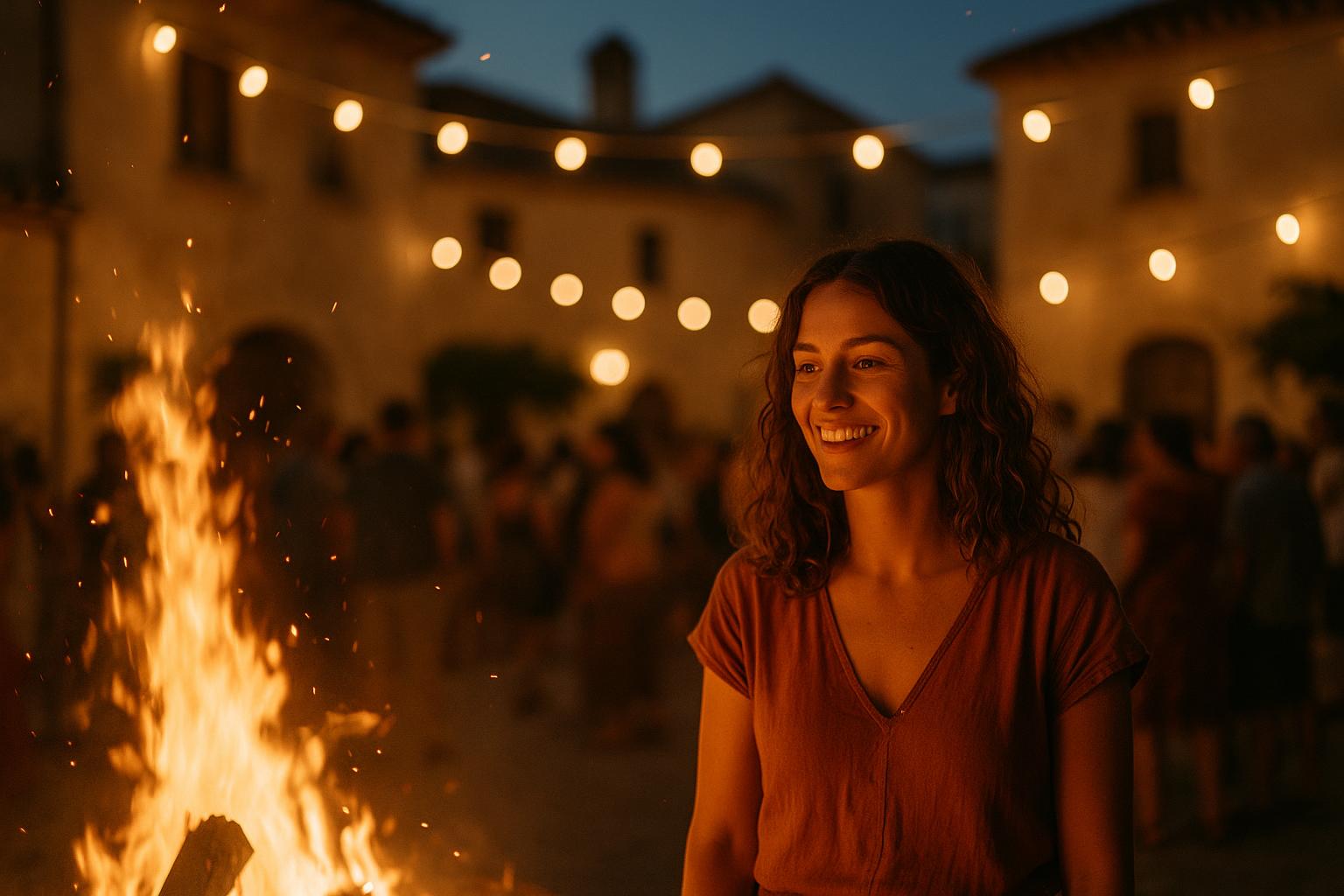
You can live in Mallorca for years and still be an outsider. Or you can go to a fogueró in January and stop being one in a single night. The festivals of this island are not folklore laid on for tourists: they are the skeleton of the year, the place where a community recognises itself. And they are, by a distance, the fastest and most honest way in.
We have been in the southeast since 2010 — Ses Salines, Santanyí, Campos, the Colònia de Sant Jordi, Felanitx — and this is what we have learned: here you do not integrate by speaking well or by owning a fine house. You integrate by showing up. This is the guide to the calendar that really matters, told by people who live it rather than by people who visit.
The fire
Sant Antoni (16-17 January): the great winter festival
If you go to only one Mallorcan festival in your life, make it this one. On the night of 16 January, the eve of Sant Antoni, the villages light foguerons — bonfires — that burn into the small hours. Around each one, people make torrada: sobrasada, botifarró and bread grilled over the embers, wine, and the whole village out in the street in the depth of January.
And out of the smoke come the dimonis. Masked, horned figures who dance, chase people and rattle their cowbells, in a re-enactment of the clash between the saint and temptation. In Artà, for instance, out come the Dimoni Gros and the Dimoni Petit, with their first dance in the morning and their parade with the band, the crowd in white with red neckerchiefs. The strongholds of the festival are Sa Pobla, Manacor, Muro, Artà and Pollença, each with its own character.
On the 17th come the beneïdes: the farmers bring their animals down into the village for the priest to bless them, because Sant Antoni is the patron of animals and of country people. You will see horses, dogs, sheep and the odd cat in a basket and hamster in its cage. It is tender and serious at once.
And there is a deeper reading: fire in the middle of January, right after the solstice, has to do with the returning light and the fertility of the land. Behind the saint there is something far older. Once you understand that, you stop seeing a picturesque festival and start seeing a farming community celebrating that the year is beginning again.
The city
Sant Sebastià (20 January): Palma takes to the streets
Three days later, it is the city’s turn. Sant Sebastià is the patron of Palma and is celebrated on 20 January, which is also an official local holiday in the city. But the heart of the festival is the revetlla on the eve, the 19th: Palma fills with foguerons and torrades and stages simultaneous concerts in the squares — Cort, Plaça Major, Plaça d’Espanya, Joan Carles I. Thousands of people having a grilled supper in the street and hopping from stage to stage.
The story is a good one, and it is worth telling properly. In 1523 Mallorca was suffering the plague. An archdeacon fleeing the Turkish advance from Rhodes reached the island carrying a relic of the saint — an arm bone — which he donated to the Seu on 3 September 1523. Popular tradition holds that the relic halted the plague. And here we should be honest: that is legend, not historical fact — the Cathedral of Mallorca itself acknowledges as much. What is documented is that in 1634, more than a century later, the Gran i General Consell named him patron of the city, displacing the Àngel Custodi.
The rest of the festival brings out the gegants i capgrossos (giants and big-heads), the xeremiers (the Mallorcan pipers) and the Drac de Na Coca emerging from Cort. There is also a correfoc, but be clear about this: it is not on the 19th, it falls on a separate date and it changes every year. If you are coming for the correfoc, check the current year’s programme and do not take last year’s date for granted.
The carnival
Es Darrers Dies: Sa Rua, Sa Rueta and the burial of the sardine
Here the Carnival is called es darrers dies: literally, “the last days”. The last days when you could eat meat before Lent. It is not a brochure name: the town hall of Manacor itself titles its official programme this way.
The first thing to understand is that it is movable: it hangs off Easter. It is counted back from Ash Wednesday, so it falls on different dates each year. And the second, a practical warning almost no one gives: Sa Rueta (the children’s and family parade) and Sa Rua (the big parade, of floats and troupes) need not be on consecutive days. In Palma, in 2026, they were a whole week apart. And each town does its own thing: in Manacor they do run almost back to back.
The moral for anyone who lives here: always check your own town hall’s programme. The tourist aggregators publish wrong dates with remarkable cheer — we have come across more than one giving days that were not right. Here the reliable source is the town hall, not the travel site.
And then there is the gem almost no outsider knows: the enterrament de la sardina (the burial of the sardine). It is not a rootless copy of a mainland custom: in Pòrtol (Marratxí) it goes back more than three decades — it is on its thirty-fourth edition — and it is a spectacle. A wake with mourners, a sardine more than two metres long, a procession, and the Dimonis des Fang lighting the bonfire and circling it three times before burning it. Afterwards, a torrada of sardines and dancing. Manacor has its own. It is the full stop of the carnival and the start of Lent.
The spring
Holy Week: processions and the smell of the bakeries
Mallorcan Holy Week is one of processions and quiet devotion, with the Palma procession the most monumental and those of the villages the most intimate. But if you ask anyone from here what Easter is, they will probably talk about food before processions.
Because it is when the bakeries fill with panades (closed pies, of meat or fish), rubiols (sweet turnovers) and crespells (biscuits, often shaped like a star or a flower). They appear, they sweep all before them, and they vanish until next year. Many families still make them at home, and that is one of those moments when, if you are invited to knead the dough, you have genuinely arrived.
The summer
Les festes: every town, its big week
From June to September the calendar fills up: every town has its festes patronals, its big week. And the patron saint changes from place to place, so the map of summer is a string of festivals one after another. Ses Salines, Santanyí, Campos, the Colònia de Sant Jordi and Felanitx have theirs, and the lovely thing is that you can go to the neighbouring village’s the way you would drop in on a friend.
The structure is usually recognisable: an opening address, activities for the children, popular competitions, a verbena — the square dance, which can run until dawn — a firework display and, in many places, a correfoc. Everyone mixes: the grandmothers on their chairs, the teenagers, the foreign residents who have got wind of it and those who have not missed one in forty years.
And on the night of Sant Joan, 24 June — also a local holiday in Palma — the solstice is celebrated with bonfires and midnight swims off the beach. It is the other great fire of the year, at the opposite end of the calendar from Sant Antoni. This island is understood rather well through its bonfires.
One important note: check your town hall’s programme. The dates of the patron festivals are fixed by the village’s saint, but the line-up of events changes every year.
The language
Mallorcan: the key almost no one uses
Here people speak Mallorquín and Spanish, switching from one to the other in daily life with complete ease. No one is going to require you to speak Mallorcan: the southeast has had an international community for decades and Spanish will see you through everything.
But here is the secret: you do not need to speak it; it is enough to try. A few words of Mallorcan in the day to day. The gesture is worth far more than getting it right. It is the sign that you have not come for the place to adapt to you. And in a village, that sign is noticed and returned.
The honest part
How you really become part of a village
We say it plainly, because we have seen it many times. The people who integrate here are not the ones with the finest house or the best dinner parties. They are the ones who do these four things:
- Show up. To the village festival, to the fogueró, to the verbena. Even if you know no one. Above all in the first year, and above all in winter, which is when the village belongs to its own.
- Buy in the village. The market, the bakery, the butcher. That is where the three-minute conversation happens which, repeated a hundred times, is what turns you into a neighbour.
- Say hello. It sounds trivial. It is not. In a village people greet one another, and the person who does not is noticed.
- Respect the rhythm. Here things move at their own speed, and the traditions are not to be judged by an outsider’s standards. You watch them, you ask, and you learn them.
The return is enormous: this is a genuinely welcoming community to those who come with respect. It is a personal, close relationship, the kind you find where a community knows and looks after its own. After years here, that is exactly what people tell us they would not trade for anything.
Common questions
Frequently asked questions about the festivals of Mallorca
Which is the most important festival in Mallorca?
For village people, Sant Antoni: the night of 16 January with the foguerons and the dimonis, and the animal beneïdes on the 17th. Sa Pobla, Manacor, Muro, Artà and Pollença are its strongholds. In Palma, the great occasion is Sant Sebastià, the patron, on 20 January, with the revetlla on the eve.
What are the foguerons and the beneïdes?
The foguerons are the bonfires lit on the eve of Sant Antoni that burn all night; around them people make torrada (sobrasada, botifarró and bread over the embers). The beneïdes are the blessing of the animals on the 17th, because Sant Antoni is the patron of animals and of country people.
When is Carnival in Mallorca?
It is movable: it falls in the days before Ash Wednesday, which in turn depends on Easter, so it changes each year. Here it is called “es darrers dies”. Note: Sa Rueta (for children) and Sa Rua (the big parade) are not always on consecutive days, and each town has its own calendar. Always check your town hall’s programme.
Is it true that the relic of Sant Sebastià stopped the plague in Palma?
It is popular tradition, but not a verified historical fact: the Cathedral of Mallorca itself places it in the realm of legend. What is documented is that the relic arrived from Rhodes and was donated to the Seu in 1523, and that Sant Sebastià was named patron of Palma in 1634, more than a century later.
Do you need to speak Mallorcan to live in Mallorca?
No. You can live perfectly well in Spanish, and the southeast has had an international community for decades. But trying a few words of Mallorcan is the gesture that most changes your relationship with your neighbours. It is not about speaking it well, but about trying.
Can you take part in the festivals if you are a foreigner?
Not only can you: it is exactly what is expected. The festes are open and participatory, and showing up is the fastest way to stop being “the outsider”. The first year is the one that counts.
Let’s talk
The calendar is what turns a house into a home
You can buy a house in Mallorca in a few months. Becoming part of the village takes a little longer, but less than people think: a couple of winters, a few foguerons and showing up when it matters. We have been in these villages since 2010 and have watched many people make that journey.
If you are thinking of taking the step, this matters as much as the square metres, and it appears in no listing. Discover what it really means to live among the most beautiful villages in Mallorca and how the island lives through its climate month by month.