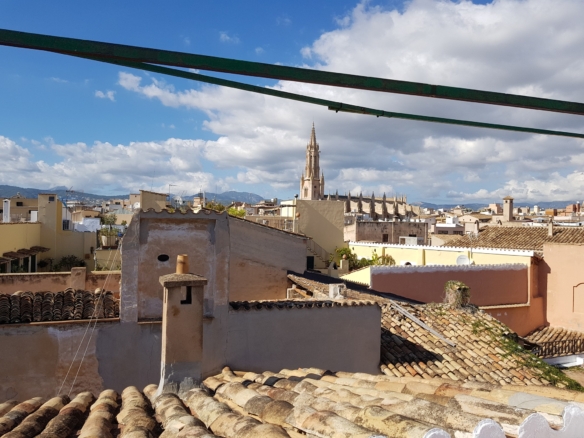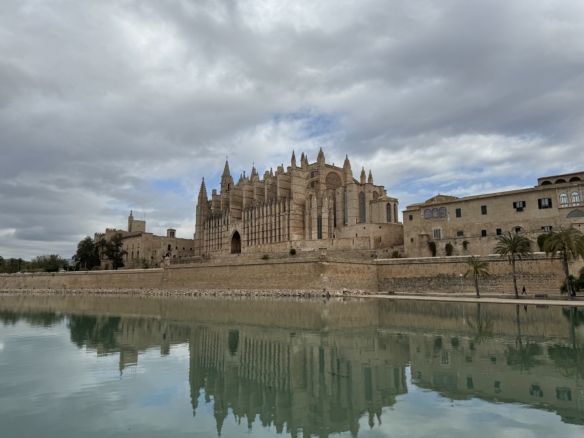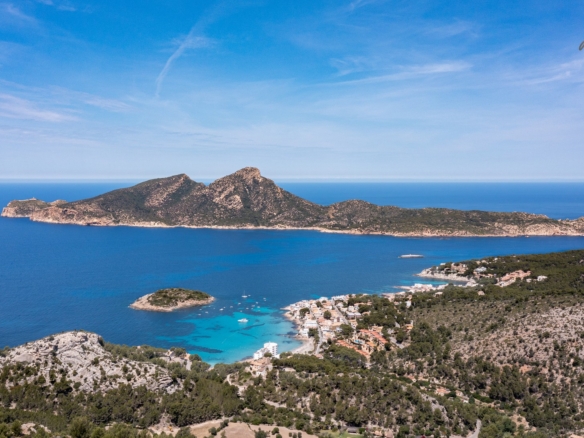

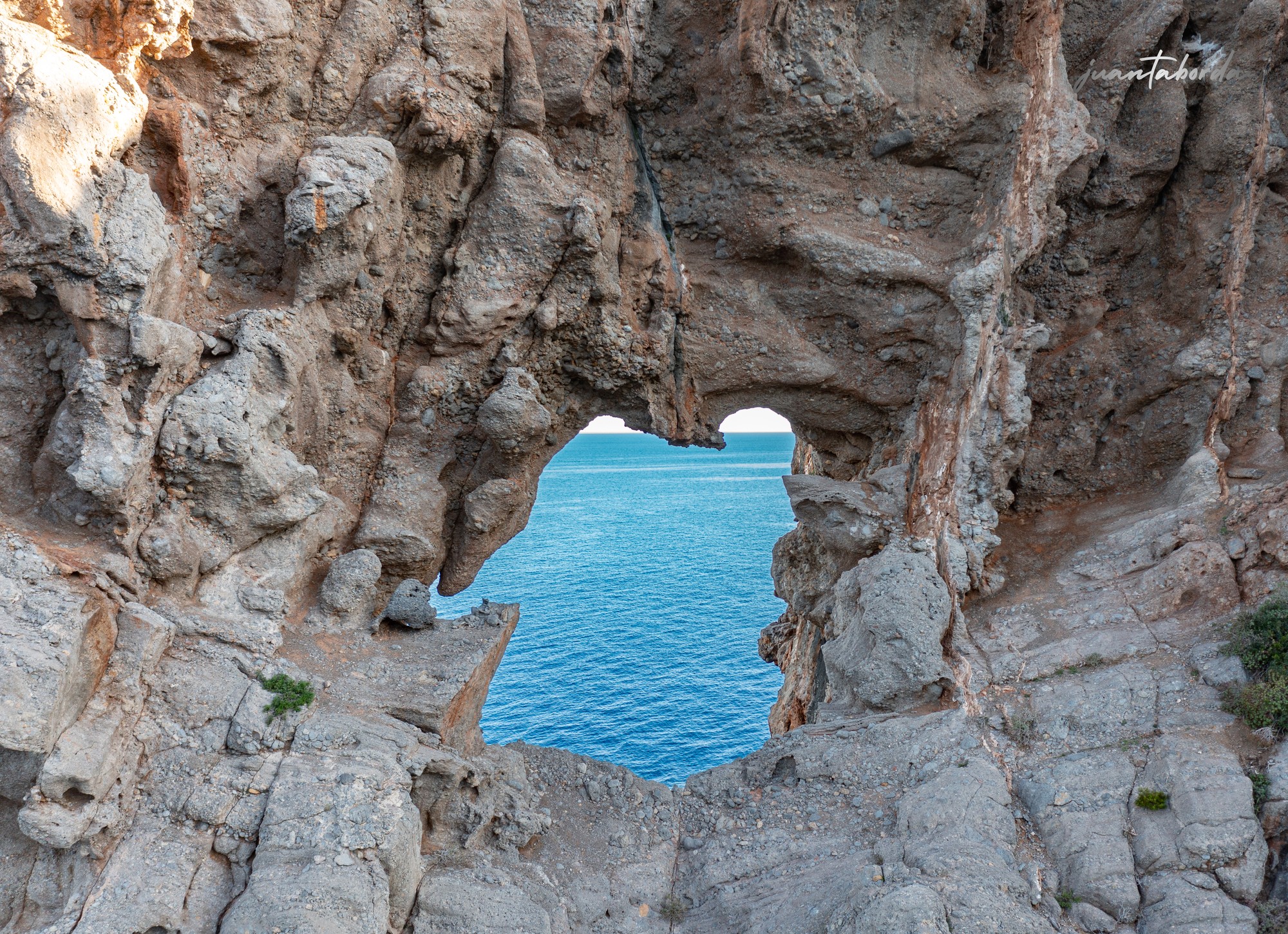
The short version: Deià is a small stone village on the north-west coast of Mallorca, built on a steep slope of the Serra de Tramuntana between the mountains and the sea. It has drawn artists and writers since the poet Robert Graves arrived, and it is home to the hotel La Residencia. The stone houses climb the hillside, reached by steps, rarely with parking. Cala Deià, its cove, is a bay of stones with two restaurants. Almost nothing comes up for sale, and Palma is about 40 minutes away by a mountain road.
Where Deià is, and what it is
Deià sits on the north-west flank of the Serra de Tramuntana, between Valldemossa, Sóller and Bunyola, about 28 km (17 miles) from Palma. According to the Ajuntament de Deià, the municipality has about five kilometers of coastline and around 711 inhabitants, spread across the village, the cove of Cala Deià, the hamlet of Llucalcari and the residential area of s’Empeltada.
The town hall traces the name to the Islamic period, from ad daia, meaning hamlet, and credits that era with the stone terraces that turned steep slopes into farmland. That terraced landscape is why the whole range is protected: on 29 June 2011, UNESCO declared the Serra de Tramuntana a World Heritage Site in the category of Cultural Landscape, according to the Consell de Mallorca. If you are still comparing areas, our guide on where to live in Mallorca places Deià next to the rest of the island.
A village of artists and writers
The story most people know begins in 1929. According to the Fundació Robert Graves, the British poet and writer Robert Graves moved to Deià that year and built a house, Can Alluny, with the proceeds of his war memoir Good-bye to All That; in 1934 he published I, Claudius, written, in the foundation’s words, to pay off a mortgage. He left when the Spanish Civil War broke out in 1936, came back with his family in 1946 and lived in Can Alluny until his death in 1985. The foundation acquired the house in 2005 and runs it as a museum, open all year, a few minutes’ walk from the village center. Graves is buried in the small cemetery in front of the parish church, at the top of the village.
He was not the only foreigner to leave a mark: the village archaeological museum was founded in 1962 by the American painter, sculptor and archaeologist William Waldren, according to the town hall.
The hotel La Residencia belongs to the same story. According to Belmond, which operates it, the estate is built around twin manor houses dating back to the 17th century, opened as a hotel in 1984 and keeps an art gallery and studios with a resident artist. One of its villas carries Graves’s name.
The houses: stone, slope and stairs
Deià is built on a hill, and every house shows it. The homes are stone, set one above the other, with terraces and gardens stepping down toward the valley and the sea. The climb to the 16th-century church of Sant Joan Baptista passes houses that the town hall describes as a fine example of the popular architecture of the mountains.
In what we see, the house that defines Deià is a stone village house with thick walls, small windows on the street side and the view on the other. Many are reached by steps rather than by a driveway, some by a lane too narrow for a car, and a few sit on the terraces around the village, among olive trees. What almost none of them has is a parking space at the door.
Parking and the car
Streets are narrow, the village climbs, and there is little room for cars. The town hall runs a regulated parking scheme, marked in orange, in Es Puig, Es Clot, Sa Vinya Vella, s’Empeltada, Llucalcari and at Cala Deià, with cards for registered residents, owners and tenants; its conditions are set by the town hall, not by this guide.
Shopping, luggage or a new sofa often travels the last stretch on foot, up or down a flight of steps. That walk from the car to the front door is the first thing a new resident learns to plan.
Getting around: Palma, the airport and the Serra
Driving times below come from OpenStreetMap routing, from the village center, in free-flowing traffic:
- Central Palma: about 28 km, around 37 minutes.
- Palma airport: about 37 km, around 43 minutes.
- Sóller and Valldemossa: about 10 to 11 km, around 16 minutes each.
In daily practice, we count on about 40 minutes to Palma. The road crosses the mountains one curve after another, with narrow stretches and cyclists, and it is the same road every day: to work, to school or to the airport. Line 203 of TIB, the island’s bus network, links Port de Sóller and Palma through Deià and Valldemossa, with seasonal timetables on the TIB website; for most residents it complements the car rather than replacing it.
Cala Deià: a cove of stones
The village has its own cove, Cala Deià, about 3 km away by road, around seven minutes in free-flowing traffic; the town hall also publishes a walking route down to it from the village. It is not a sandy beach: it is a small bay of stones and rocks with clear water and two restaurants right above the sea, which is what the second half of the video above shows.
Parking at the cove is tiny and part of the regulated scheme. In summer, the spaces fill early; residents go down at the start of the day, on foot or out of season.
Summer and winter
Deià lives two seasons. From spring to early autumn it fills during the day with visitors on the main street and at the cove. Walkers pass through as well: the GR 221, the dry-stone route across the Serra, crosses the municipality, which has its own mountain refuge, Can Boi, according to the town hall.
In winter, Deià belongs to the people who live here: low light over the terraces, empty lanes and the rhythm of a mountain village of a few hundred people. Compared with Sóller, which keeps the life of a town all year, Deià is more seasonal, and for many who settle here that winter calm is the point.
Services, schools and daily life
Deià has shops, cafés and restaurants, listed on the town hall’s website. Its public school, the Col·legi Públic Robert Graves, takes children from three to twelve, and the village health unit opens two mornings a week. For everything else, residents drive to Sóller or Palma. For families who need an international school, the schools are on the Palma side; our guide to international schools in Mallorca lists each one with official data.
Buying in Deià: when a house comes up
The most important thing to know about buying here is that almost nothing comes up for sale. In what we see, homes in Deià are bought when they appear, not when the buyer happens to be looking. A search here follows the village’s calendar; when a house does come up, the buyers ready to visit and decide quickly are the ones who get it.
Well-known names in Deià
Andrew Lloyd Webber bought a house in Deià in 2003 (Majorca Daily Bulletin, July 2003) and celebrated his 60th birthday in the village in 2008 (Mallorca Magazin, March 2008). Along the same coast, Michael Douglas bought an estate between Valldemossa and Deià in 1990 (Hello magazine, 2023; Ultima Hora, September 2025). Well-known faces turn up at restaurants in Deià and are treated like any other guest. Our guide to celebrities in Mallorca goes area by area, with every name reported by at least two news outlets and no addresses.
What nobody tells you
The stairs are daily life. A house reached by a long flight of steps is beautiful on the first visit and a decision on the hundredth, with luggage or groceries.
The road is part of the house. Forty minutes of curves is a pleasure on a Sunday and a commute on a Monday, so anyone who will drive to Palma daily does well to try it at rush hour first. And the village is shared: in summer the main street belongs as much to visitors as to residents. Seeing Deià in both seasons gives a clearer picture than any description.
What you need to know
How far is Deià from Palma?
About 28 km, around 37 minutes in free-flowing traffic by OpenStreetMap routing. In daily practice, with the mountain curves, we count on about 40 minutes.
How far is Deià from Palma airport?
About 37 km, around 43 minutes in free-flowing traffic, by OpenStreetMap routing.
Did Robert Graves live in Deià?
Yes. He moved to Deià in 1929, built his house, Can Alluny, and lived there from 1946 until his death in 1985. The Fundació Robert Graves runs it as a museum, open all year.
Is there a beach in Deià?
Deià has a cove, Cala Deià, about seven minutes away by road: a bay of stones and rocks, not sand, with two restaurants above the water and very little parking.
Are there houses for sale in Deià?
Very few. Almost nothing comes up for sale, and in what we see, houses are bought when they appear.
Where we work
We work across Mallorca from our base in the south-east, where you can browse homes in Santanyí, homes in Ses Salines and homes in Campos. If Deià or any other village of the Serra de Tramuntana is on your list, contact Villas y Fincas Mallorca and we will answer in English.
Updated October 2026. Driving times come from OpenStreetMap routing and vary with traffic and season; facts about the village, parking, bus and services come from the Ajuntament de Deià, those about Robert Graves from the Fundació Robert Graves, those about the hotel from Belmond and the UNESCO listing from the Consell de Mallorca, all consulted in October 2026. Each celebrity reference was reported by at least two news outlets. The descriptions reflect what we see with our clients and are for general information only.