
The short version: Santa Catalina is the neighborhood just west of Palma’s old town, built around the city’s oldest municipal market, with the windmills of Es Jonquet and the seafront promenade at its edge. Most homes are two-story townhouses and renovated apartments, and few have a garage. By day it lives like a village inside the city; at night its restaurants fill the streets, and with them comes noise. This guide explains what living there is like.
From sailors and millers to the neighborhood of the moment
Santa Catalina was the first neighborhood Palma built outside its city walls, as the city’s own tourism foundation, Visit Palma, puts it. For centuries it was a district of sailors and fishermen, with flour mills on the rise toward the sea and boatyards where the Sa Riera stream reaches the bay. The streets that grew from that past are laid out on a regular grid, lined with low houses, and a short walk from the old town across the Sa Feixina park.
Over the last two decades, it has become the neighborhood people talk about. Restaurants, independent shops and wine bars have moved into ground floors that once held workshops and grocers. In our guide to where to live in Mallorca, it appears as one of Palma’s four main neighborhoods. Here we look at it in detail, from the point of view of someone thinking of making it home.
The market at the center of the week
Everything in Santa Catalina orbits around the Mercat de Santa Catalina, which describes itself as the dean of Palma’s municipal markets, the oldest of them. It is a covered market with fishmongers, butchers, fruit and vegetable stalls, bakeries, florists and wine shops, and a ring of small bars where people stop for coffee in the morning and for a glass of wine and something to eat at midday.
According to the market’s own published schedule, it opens Monday to Saturday: the shops from 7 am to 3 pm, and the bars and food stalls from 7 am to 5 pm. The fishmongers close on Mondays, and the market closes on Sundays and on public holidays it announces in advance. Saturday morning is the busiest moment of the week, when residents doing their shopping share the aisles with visitors having a drink.
For a resident, it means fresh fish, meat and produce a few minutes’ walk away, and a morning coffee at the counter where the neighborhood meets.
Es Jonquet, the windmills and the seafront
On the southern edge of Santa Catalina, between its streets and the sea, lies Es Jonquet, the oldest part of the area. An official heritage report published in Spain’s Official State Gazette in 2008 describes it as a fabric of small traditional Mallorcan houses, and lists its flour windmills by name: En Gelós, La Garriguera, En Budellet, Nom de Déu and En Garleta. The mills still stand on the rise above the water, and they are the image most people keep of this corner of Palma.
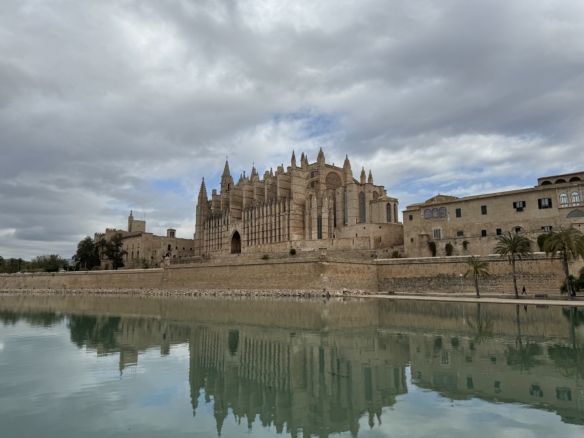
Below them runs the Passeig Marítim, the seafront promenade that follows the bay of Palma, with the marinas, the cathedral in the distance and a wide promenade where people walk, run and cycle every day. For residents of Santa Catalina, the sea is not a weekend trip: it is the end of the street.
What the homes are like
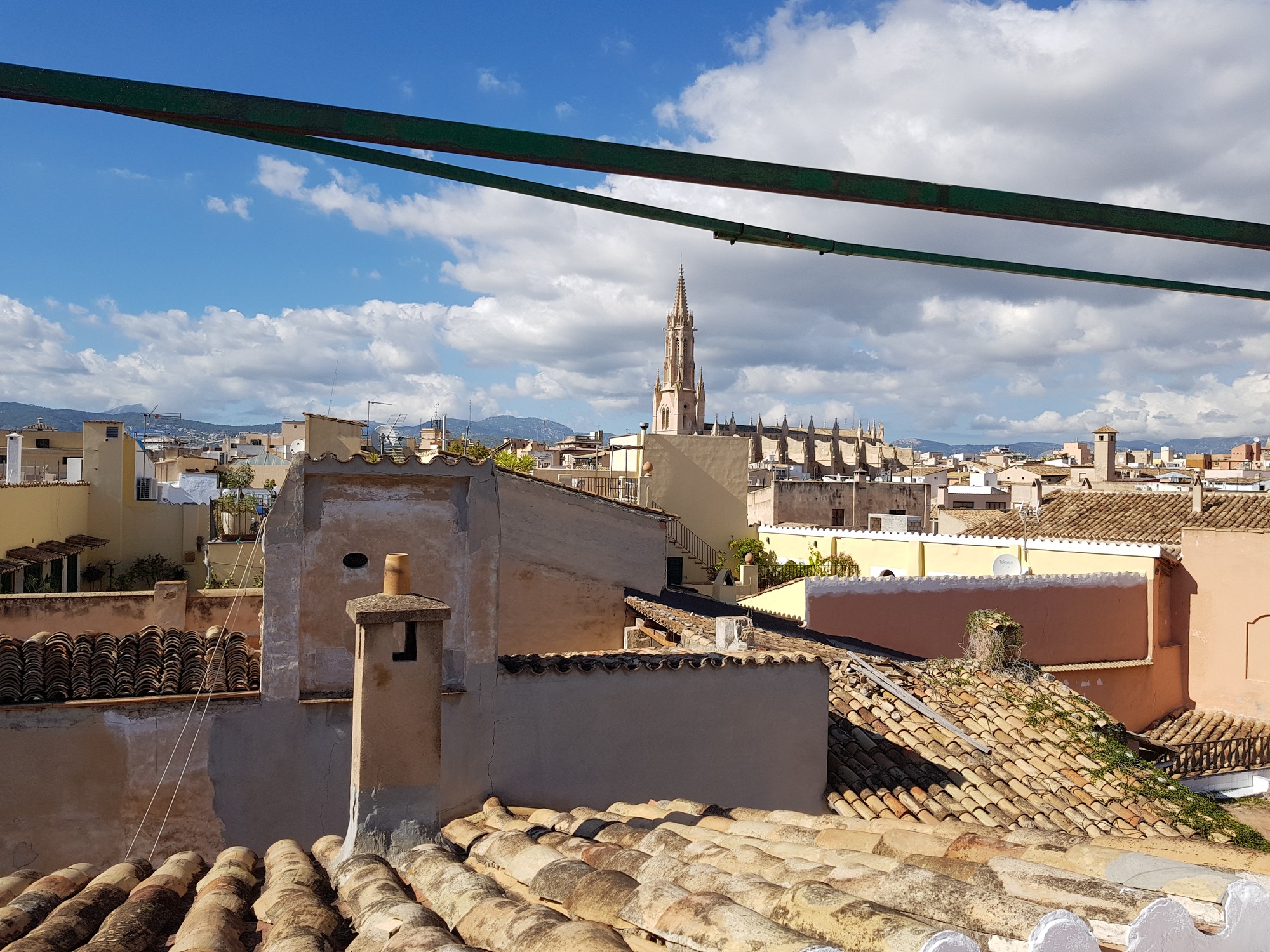
The typical home in Santa Catalina is the townhouse: a narrow two-story house on the street, often with a small patio at the back and a roof terrace, built for the families of sailors, fishermen and craftsmen. Many have been renovated, keeping the original stone and beams where they survived. In Es Jonquet the houses are smaller still, and the streets are steeper and quieter.
Alongside the townhouses there are apartment buildings, from older blocks to recent renovations with elevators and terraces, which suit those who travel often. What there is very little of is parking. Few townhouses have a garage, and in what we see, a home with its own parking space is one of the most sought-after features in the neighborhood.
When we show a home in Santa Catalina, three questions usually come up first: how much natural light reaches the ground floor, whether the roof terrace is private and usable, and what the street is like at night. The first two can be seen on a visit; the third deserves a visit of its own.
Day and night: two rhythms on the same street
Santa Catalina has two lives. By day it is a neighborhood in the old sense: the market, the bakery, the hardware store, children walking to school, neighbors talking at the door. From the evening on, it becomes one of the busiest dining areas in Palma, and Visit Palma itself recommends it above all for the evening and the night.
For a resident, that means noise, and how much depends on the exact street. What we see is that the restaurants and bars cluster around the market and the main streets of the neighborhood, while other streets, a block away, are much calmer, and parts of Es Jonquet remain quiet. In summer the terraces stay full late, and the noise follows them.
Double glazing, the orientation of the bedrooms and a room at the back can make a great difference to the noise.
Getting around: on foot, by bike and by bus
Santa Catalina is a walking neighborhood. The old town, the cathedral and the shops of the center are a short walk away across the Sa Feixina park, and the seafront is at the end of the street.
For longer trips within the city, Palma has its public bike-share, BiciPalma, with mechanical and electric bikes unlocked from an app, and the seafront path is the natural route east toward the old town and beyond. The municipal bus company, EMT Palma, runs the city network, and its website and app show the stops and lines closest to any address, including the airport bus.
The car is the difficult part. Streets are narrow, parking on the street is scarce, and as we said, few houses have a garage. Many of those who need a car every day rent a space in a nearby garage, and that is worth checking before buying rather than after.
Schools, services and everyday life
Living in Santa Catalina means having the city at hand: pharmacies, health centers, banks, gyms, supermarkets and the market itself are all within walking distance, and Palma’s main hospitals and the airport are a short drive away. Fiber internet is standard in the city.
Families should know that most international schools are spread around Palma and the surrounding municipalities, so the school run usually means a car or a school bus. Our guide to international schools lists them with distances and official details.
Who we see buying in Santa Catalina
In what we see with our clients, three profiles buy in Santa Catalina. The first is the young professional who works remotely: someone who wants a city life on foot, good coffee and the sea at the end of the street, and who travels often enough to value a home that is easy to close. The second is the buyer from the Nordic countries, a visible presence in the neighborhood that can be felt in its shops and restaurants. The third is the American buyer, who is often looking for exactly this: a walkable neighborhood with character, an international atmosphere and a direct connection with everyday Mallorcan life.
What they have in common is that they choose Santa Catalina for the life outside the front door rather than for the size of the house. Those who want a garden, a pool and silence usually look elsewhere on the island.
What nobody tells you
A few things that newcomers usually discover only after moving in. The neighborhood is busiest exactly when residents want to rest: Friday and Saturday nights in summer. Townhouses are narrow, and stairs are part of daily life, which matters for anyone with reduced mobility or very young children. And renovations in old houses take time: the walls, the beams and the installations are often older than they look.
None of this puts off the people who choose Santa Catalina; it simply helps to see the house more than once, at different times of day.
What you need to know
Where is Santa Catalina in Palma?
Just west of the old town, between the Sa Feixina park and the seafront. It was the first neighborhood built outside Palma’s city walls, and the old town is a short walk away.
What kind of homes are there in Santa Catalina?
Mostly two-story townhouses, many of them renovated, and apartments in older and recently renovated buildings. Few homes have a garage, and in Es Jonquet the houses are smaller.
Is Santa Catalina noisy at night?
It depends on the street. Restaurants and bars cluster around the market and the main streets, and noise rises on summer weekends; other streets and parts of Es Jonquet are much calmer.
When is the Santa Catalina market open?
Monday to Saturday: shops from 7 am to 3 pm and bars and food stalls from 7 am to 5 pm, according to the market’s own schedule. Fishmongers close on Mondays; the market is closed on Sundays.
Do you need a car to live in Santa Catalina?
Not for daily life: the center, the market and the seafront are within walking distance, and there are city buses and public bikes. Parking is the difficulty, so many residents rent a garage space.
Where we work
We work across Mallorca from our base in the south-east, where you can browse homes in Santanyí, homes in Ses Salines and homes in Campos. If you are considering Santa Catalina or any other part of Palma, contact Villas y Fincas Mallorca and we will answer in English.
Updated October 2026. Market hours can change; the descriptions of the neighborhood reflect the official sources we consulted in October 2026 and what we see with our clients, and are for general information only.