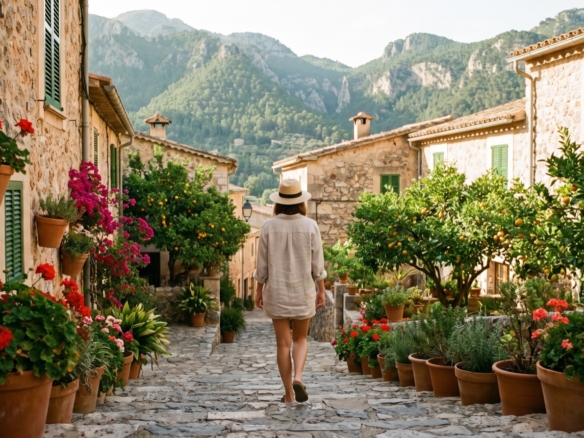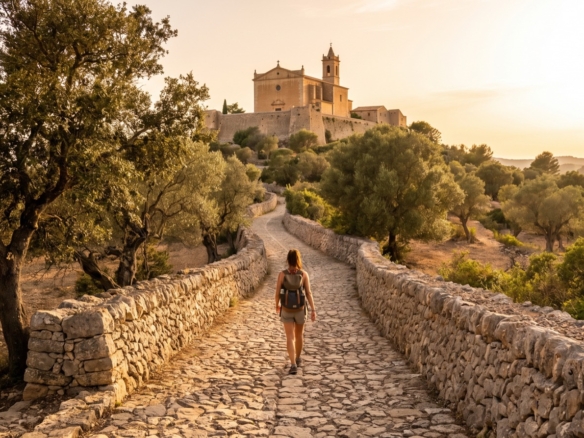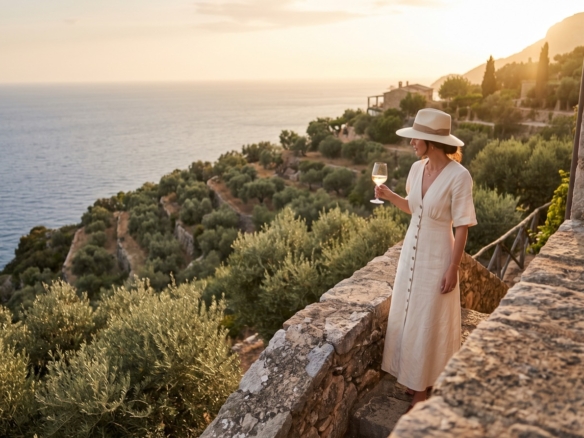

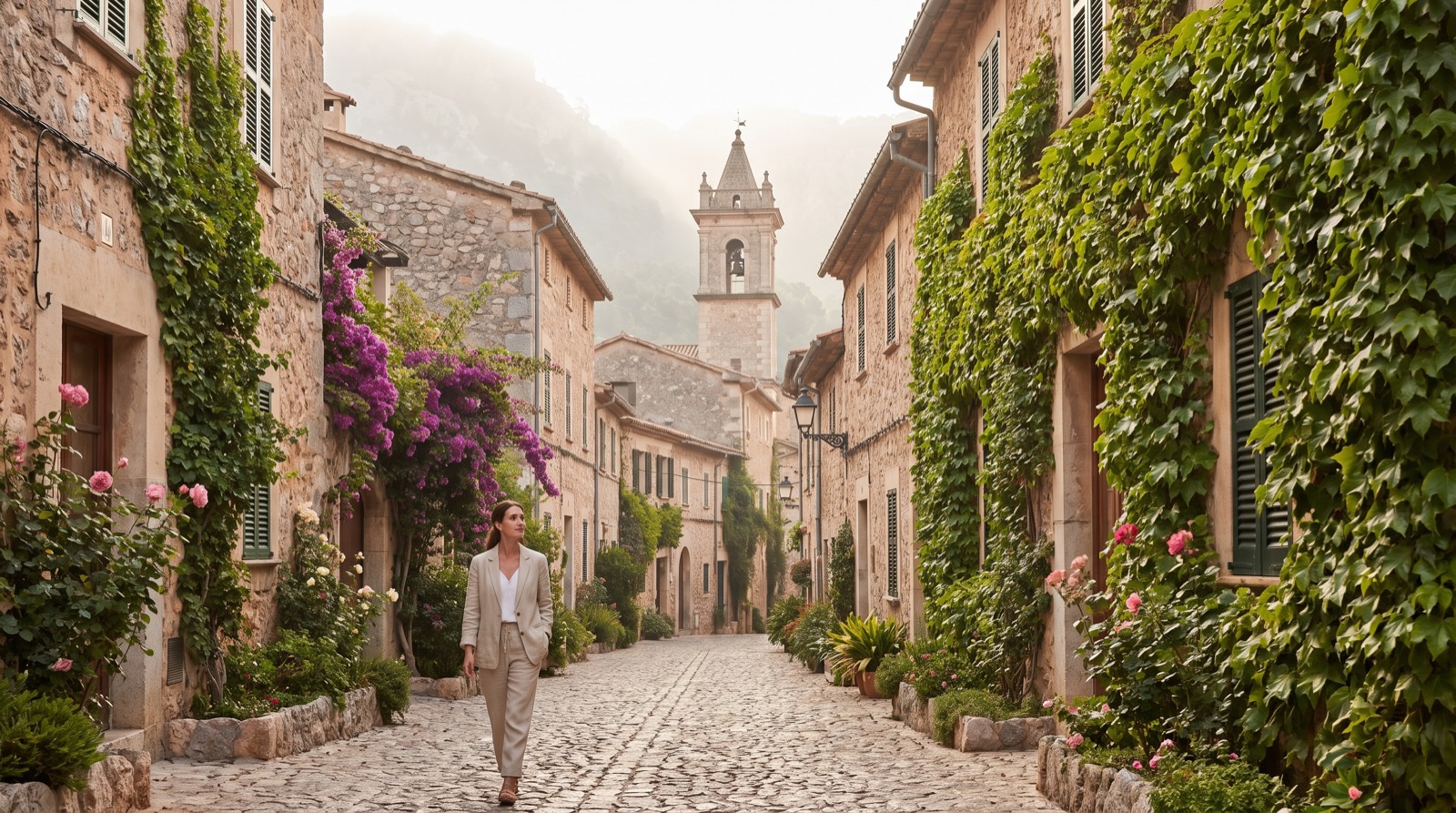
Valldemossa is one of the most beautiful villages in Mallorca, and one of the most honest when you look closely: extraordinarily lovely, heavily visited in season, with a genuine character that comes through clearly once the tourism fades. Its cobbled streets, its stone houses draped in flowerpots, the Real Cartuja and the coca de patata that smells of sugar and lemon are all part of a very specific identity. And the setting — the Serra de Tramuntana, a UNESCO World Heritage Site, with its centuries-old olive trees and its views out to the sea — does the rest. Palma is twenty minutes away. The airport, twenty-five. For anyone who wants mountains, beauty and connection without giving up any of the three, Valldemossa is one of the best options on the island.
Set in the mountains at around 400 metres above sea level, the municipality of Valldemossa takes in the historic village centre along with a handful of country houses and developments in the surrounding area. It’s a place for permanent residents, for second homes and for those who work in Palma but want to live in a radically different setting. The community has a varied profile: lifelong Mallorcans, families looking for quiet and nature, and an international community of artists, writers and remote professionals following in the footsteps of everyone who chose this place before them.
Real life
What it’s really like to live in Valldemossa all year round
Valldemossa has a life of its own all twelve months, though with two very different faces. From June to September the village draws a considerable flow of visitors — above all in July and August, when the Cartuja can have queues and parking in the old centre becomes genuinely tricky. From October to May, by contrast, Valldemossa returns to its residents: quiet, with the streets there to be walked with no one around, the cafés in the centre full of familiar faces and the mountains at their best, green and wrapped in low morning mist.
For everyday shopping, the village has a handful of small shops and a dining scene that works all year. For a big supermarket, Palma (20 min) or Esporles/Establiments are the usual reference. Locals take that drive as part of the rhythm of living here. The village health centre covers primary care; for specialists or emergencies, the hospital is in Palma, twenty minutes away, which is very reasonable. There’s a primary school in the village; for secondary education, pupils go to Palma or to schools in the Raiguer.
The social atmosphere in Valldemossa is much valued: there’s a very active life of village associations and fiestas, and the mix of permanent residents with the international community makes for an interesting social fabric. It isn’t a village for nightlife — that stays in Palma — but it is one for long conversations and gatherings in the square when the weather is good.
The Cartuja
Chopin, George Sand and the Real Cartuja de Valldemossa
The building that defines Valldemossa is the Real Cartuja, a former Carthusian monastery founded in 1399 — first as a royal palace, later as a charterhouse — that presides over the village from the top of the old centre. The Cartuja passed through different hands over the centuries and today is part museum, part private accommodation in the restored cells.
Its name is associated internationally with the winter spent here by the Polish composer Frédéric Chopin and the French writer George Sand, between November 1838 and February 1839. It was a wet, difficult winter — Chopin was already ill with tuberculosis — but enormously productive: it was here that he composed his celebrated Preludes, Op. 28. The cell he occupied, with the Pleyel piano that reached him from Paris, can be visited in the Cartuja museum. The stay was immortalised in George Sand’s book A Winter in Majorca, which has the added distinction of having thoroughly irritated the Mallorcans of the day.
Today the Cartuja can be visited as a museum and is one of the most visited tourist attractions in Mallorca. For anyone living in the village, the privilege is having it on the doorstep in the quiet months, when you can walk through it almost alone.
The village saint
Santa Catalina Thomàs and the Festa de la Beata
The religious and popular identity of Valldemossa has a name of its own: Santa Catalina Thomàs (1531-1574), born in the village and canonised in 1930, is the most beloved saint in Mallorca. Her birthplace — Ca la Beata — can be visited in the old centre, and her presence is felt in the images on every corner, in the flowerpots bearing her portrait and in the festival that each year turns the village into a place of pilgrimage.
The Festa de la Beata, held on the last Sunday of July, is one of the most colourful and best-attended processions on the island: floats, traditional costumes, the singing of goigs and a genuine popular devotion that has been repeated for centuries. It’s one of those events worth seeing even if you’re not from the village, and one that those who live here experience in a completely different way from the visitor.
The taste of the village
Coca de patata: the sweet treat of Valldemossa
Among all the flavours of Mallorca, Valldemossa has one all its own: the coca de patata, a soft, fluffy sponge made with boiled potato and icing sugar, baked in the village’s pastry shops and served with hot chocolate on winter days. It’s one of those products that only truly taste right where they’re made, and the people of Valldemossa know it. The village bakery makes versions that have turned the coca into a first-rate gastronomic souvenir, and it’s a fixture at the village fiestas. For anyone who lives here, the smell of freshly baked coca on a November Sunday is part of the weekend ritual.
Nature
Hiking and activities in the Serra de Tramuntana
The setting around Valldemossa is pure Tramuntana: stone paths, thousand-year-old olive groves, ravines and viewpoints looking out to the sea. Several walking routes of varying difficulty set off from the village. The one that leads to the Miranda des Lladoner viewpoint — with panoramic views of the valley and the sea — is accessible and spectacular. The road between Valldemossa and Deià is one of the most famous cycling routes on the island and an uncommonly beautiful drive, with the mountains on one side and the Mediterranean on the other.
For the more active, the Tramuntana trails leaving from the municipality connect with multi-day routes through the range, giving access to some of the most impressive landscapes of the natural park. In spring — from March to May — the surroundings are at their best: intense green, wildflowers, no heat and no crowds.
The Chopin Festival, held each summer in the cloister of the Cartuja, draws pianists and enthusiasts from around the world and is one of the most evocative classical music festivals in the Mediterranean. For locals, having that on the doorstep on an August Friday is a quiet, exceptional privilege.
Logistics
Connections: Palma 20 min, airport 25 min
One of the great advantages of Valldemossa over other Tramuntana villages is its proximity to Palma: around 17-20 kilometres along the MA-1110, which in normal conditions takes 20-25 minutes. The airport is about 25-30 minutes away, making it one of the best-connected mountain villages in the whole range. That accessibility to the capital is one of the factors that explains why Valldemossa works well for both a first and a second home.
A car is essential for comfortable living here. There are regular buses to Palma, which make the trip in around 30-35 minutes and are a viable option for commuting, but for day-to-day village life and the mountain roads your own vehicle is the practical choice. The roads are mountain roads — narrow and winding — but they’re the roads of the Mallorcan Tramuntana: well maintained and perfectly navigable with care.
Where to live
What property is like in Valldemossa
The property market in Valldemossa is that of a premium Tramuntana village: stone houses in the old centre, country houses with olive groves in the surrounding area, and a few modern villas with views. Prices are high — a reflection of the beauty, the proximity to Palma and international demand — but they don’t reach the extreme of Deià. For anyone after the Tramuntana with more accessibility and a slightly more reasonable price than the most exclusive spots, Valldemossa is a good position.
There are very high-end second homes and also permanent residents of very varied profiles. The rental market is scarce and prices reflect the high-season tourist demand. For buying, supply is limited and you need to know the market well: the best properties go through referrals before they ever appear publicly. We know it, and we can guide you.
Common questions
Frequently asked questions about living in Valldemossa
Does Valldemossa have enough services for year-round living?
Yes, with some caveats. It has a health centre, a primary school, a few shops and bars. For a big supermarket, a specialist doctor or a secondary school you have to go to Palma, which is 20 minutes away. It’s a trip locals take in their stride, but it’s worth knowing in advance. For anyone working remotely with a car, it’s no real limitation.
Is tourism in Valldemossa very disruptive?
In July and August, yes, there’s a notable influx: the Cartuja receives many visitors and parking in the centre can be hard at midday. From October to May the village is quiet and tourism practically disappears. Locals learn to manage that seasonality: in summer they avoid the peak hours, and the rest of the year the village is theirs. The Cartuja in November with four people is a very different experience from August.
Is Valldemossa well connected to Palma and the airport?
Yes, it’s one of the best-connected mountain villages in the Tramuntana. Palma is 17-20 km and around 20-25 minutes by car. The airport, about 25-30 minutes. There’s a regular bus to Palma. For living here and working in the capital, it’s perfectly viable.
Is Valldemossa suitable for families with children?
Yes. It has a primary school in the village and an exceptional natural setting for children. For secondary education you have to go to Palma or to schools in the Raiguer, which means a trip by school transport or by car. It’s a quiet, safe village, much appreciated by families looking for quality of life away from the bustle, with the capital twenty minutes away if needed.
Why is Valldemossa so well known outside Mallorca?
Mainly for the stay of Chopin and George Sand at the Cartuja in 1838-39 — which Sand immortalised in A Winter in Majorca — and for the beauty of the village itself, which has been a photographic and artistic destination for decades. The combination of Tramuntana landscape, stone architecture and that cultural heritage means it appears on every list of the most beautiful villages in Spain and Europe.
What makes Valldemossa different from other Tramuntana villages?
The combination of beauty, cultural history (Chopin, George Sand, Santa Catalina Thomàs), proximity to Palma and the mountain setting. Compared with Sóller, it’s more intimate and without the commercial bustle of the tourist train. Compared with Deià, it has more services and is somewhat less expensive. Compared with Fornalutx, it has more life of its own. It’s the point of balance between postcard beauty and the practicality of a real village.
Is it for you?
Is Valldemossa the place you’re looking for?
Valldemossa is a very good fit if you’re looking for Tramuntana beauty with Palma twenty minutes away, don’t mind managing the summer tourism in the village itself, value history and a cultural atmosphere, and want a place to live that is among the most beautiful on the island. It’s less suited if you need every service within the municipality itself, if high-season tourism on the street feels uncomfortable to you, or if you’re after the extreme exclusivity of Deià or the full life of Sóller.
If you can picture yourself living in Valldemossa or in the Tramuntana, write to us: we know the mountains well and would be delighted to help you find your place.