
The short version: marès is the soft, sand-colored stone Mallorca is built of: a calcarenite, made of sand-sized grains of shell and lime cemented together, lying under more than a quarter of the island. For centuries quarrymen called trencadors cut it by hand along the south coast and shipped it to Palma, where it went into Bellver Castle, the cathedral, the Llotja and the city walls, and into the village houses of the south-east. This is the story of that stone, told from official and academic sources.
What marès is
In 2017 the Boletín Geológico y Minero, the journal of Spain’s geological survey, published a study defining the stone. Its author describes Mallorcan marès as a calcarenite: a sedimentary rock made mostly of calcium carbonate, more than half of it sand-sized grains of shell, lime and rock, bound by a natural cement. It is porous, generally very soft and easy to cut, and it was the island’s building stone for centuries, until reinforced concrete replaced it. The name means “of the sea”, yet marès formed both under the sea and from wind-blown dunes, and its types range from about 14 million to about 20,000 years old.
The exhibition panels of the University of the Balearic Islands give the scale: marès covers 937 of the island’s 3,365 square kilometers and appears in 32 of its 53 municipalities. Llucmajor, Santanyí, Manacor, Campos and Palma hold 60 percent of it, and more than 1,400 marès quarries have existed on Mallorca.
The stone inside Palma’s landmarks
The same panels call marès Mallorca’s building material par excellence, used for the cathedral, Bellver Castle and the Llotja as much as for anonymous houses.
Bellver Castle was begun in 1300 for King Jaume II, according to the castle’s official site. The 2017 study records, citing an account from 1806, that its main stone was a marès quarried beneath the castle itself, with smaller amounts of marès from Portals and of Santanyí stone, and that the marks stonemasons cut into their blocks to be paid can still be seen on many of its pieces.
The cathedral, La Seu, came by sea. At Portals Vells, in Calvià, the municipal tourism office describes the Cova de la Mare de Déu as an old quarry from which blocks were cut to build Palma Cathedral and the church of Santa Eulàlia. On the Llucmajor coast, an area still called Les Pedreres de la Seu, “the cathedral quarries”, shows a shoreline reshaped by the stone taken for the cathedral and other buildings; being by the water, notes Visit Llucmajor, made it easy to ship the blocks. The cathedral’s own history recalls that the earthquake of 1851 put the main façade at risk and that a new one was built; the 2017 study adds that marès from the Fontsanta quarries, in Palma, was given for that rebuilding.
The Llotja, the merchants’ exchange, was commissioned from Guillem Sagrera in the 15th century. The Balearic Government’s heritage page describes a single great hall with an octagonal tower at each corner, built beside the sea as part of the maritime wall. The geological study counts it among the marès buildings and notes that a layer of Santanyí stone called favat was used outdoors, in its towers.
The walls drew on the south-east too. According to the Ajuntament de Campos, the rocky rise full of caves that gave Ses Covetes its name was quarried away to raise Palma’s Renaissance wall.
Santanyí, the other stone
Santanyí has a stone of its own. The Ajuntament de Santanyí records that its parish church, begun in 1786, is built of pedra de Santanyí, and that the stone was shipped from Cala Figuera. Tradition treats it as different from marès; the 2017 study includes it because it is also a calcarenite, easy to work and long used in building, though harder, ash-white and prized for finishes and carving. See our guide to Santanyí, Cala Figuera and Es Llombards.
The trencadors of the south coast
The university panels trace the trade to the medieval stonemasons’ guild. Llucmajor’s stonemasons broke away from the city guild in 1604, and the marès quarrymen formed their own in 1663. For centuries they worked the coast of Llucmajor, documented at least since 1347: they built small huts and stayed all week, planted fig trees in the quarry pits and loaded the blocks onto barges for Palma, returning to the village on weekends.
At the end of the 19th century they began to settle where they worked. Visit Llucmajor explains that marès outcrops cover 41 percent of the municipality and that the quarries around s’Arenal gave rise to a village of quarrymen and fishermen. The railway from Palma to Santanyí, opened in 1916, ran through it, and the panels note that it carried marès. Workers came from villages such as Muro, Petra, Algaida and Porreres, and next door, in Palma, ses Cadenes took its name from the chains at the railway crossing. Those inland towns are in our guide to the Pla.
How a block was cut
Hand quarrying, a la mala, began by listening. The panels explain that stone that “sings”, with a ringing sound, is sound marès; a dull sound may hide holes and cracks. The quarryman cleared the hard surface crust, marked two pieces of 80 by 40 centimeters with a gauge, and grooved around them with the escodra, the trencador’s cutting tool, to 30 centimeters deep, the “emperor” thickness, or 25, the “king”. Iron plates and wedges went into the grooves, a mallet drove them, and the blocks came free. A hoist called a molí lifted each one out; the tallant dressed it, and a hand saw cut it into slabs from about 6 to 20 centimeters thick.
The 1950s brought machines: the panels describe the regatadora, a cutter running on rails with vertical, horizontal and cross discs tipped with tungsten carbide, and Visit Llucmajor records a patent for a marès extraction machine in 1958, after which the hand trade faded away. Today, the geological study notes, marès is cut with discs, chainsaws or diamond wire.
Where the quarries can still be seen
Old quarries are easy to miss, the panels observe, because they go down from ground level in flat country. Some can be seen from public places. In Portals Vells, the Cova de la Mare de Déu sits by the cove, near the area in our guide to Santa Ponça and Sol de Mallorca. In s’Arenal, Visit Llucmajor points to quarry cuts in the fields and on the shore, a reproduction of a block hoist in Joan Ferrer park and the Pancaritat pilgrimage, held in a quarry at Son Verí. Ses Covetes appears in our guide to Es Trenc.
The trade lives on in ses Cadenes, which has held the corregudes de marès, races carrying blocks, every year since 1989. As for the stone itself, the 2017 study recorded working quarries in municipalities such as Felanitx, Muro, Santa Margalida and Llucmajor; they are private businesses, not places to visit.
Marès in village houses and garden walls
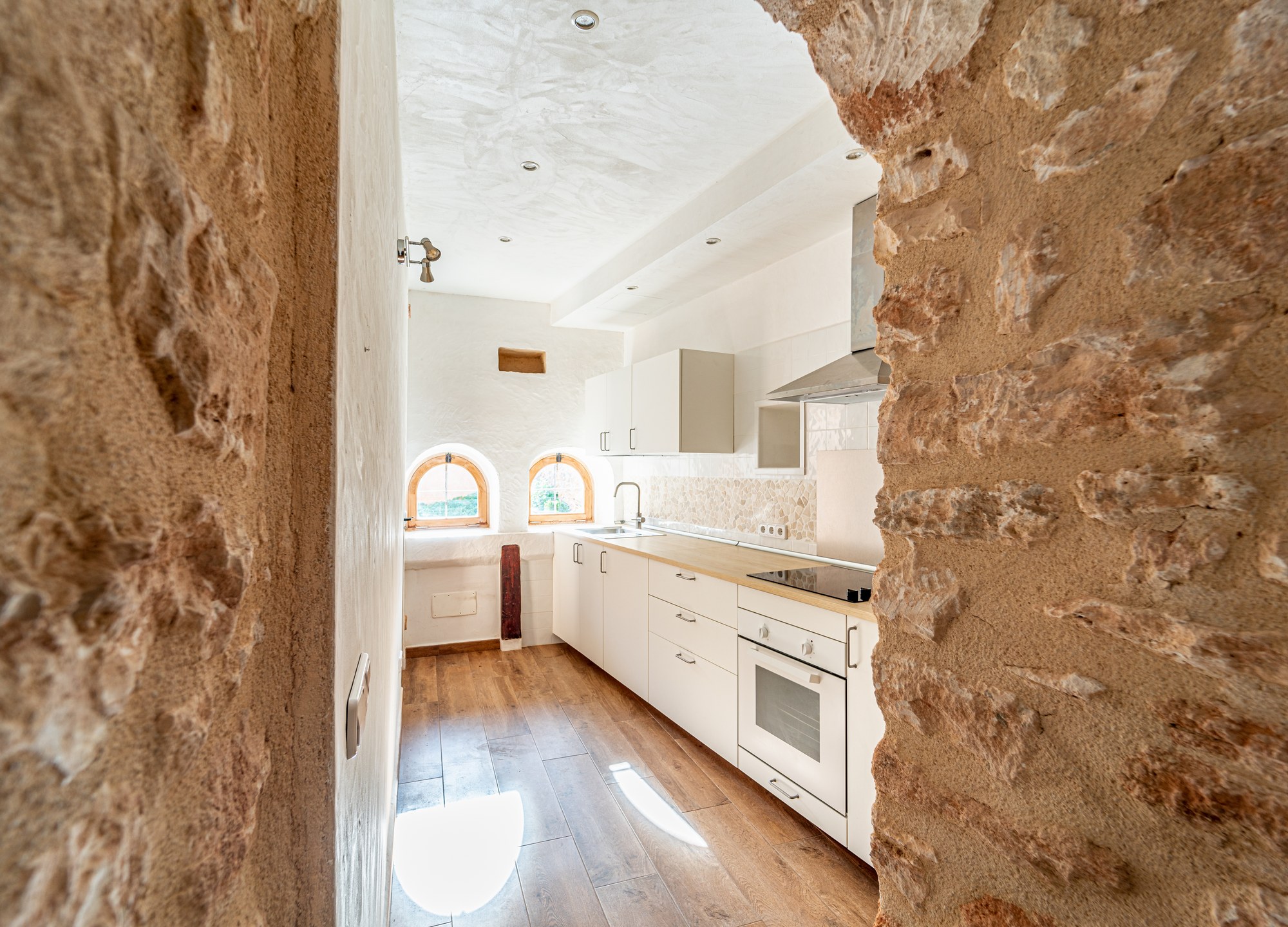
The study also lists the colors: an almost pure white marès from Muro, the ash-white of Santanyí stone, the sandy yellow of s’Arenal, the orange “marès of Porreres” and the reddish stone of Manacor and Petra. In what we see in the south-east, marès forms the walls of village houses, the corner stones, the lintels over doors and windows and the garden walls of country houses. Some façades show the bare blocks; many are rendered and painted.
Because marès is porous, old walls show their age: on ground floors and near the sea it is common to see stone worn soft at the surface, or a white bloom of salt where moisture rises and dries. What that means for a particular house is a question for the architect or surveyor who inspects it. How these houses are laid out is in our guide to casas de pueblo, and the stone palaces of the capital in our guide to Palma’s old town.
An American way to picture it
Indiana has the pale limestone of its courthouses and capitols; Brooklyn has the brownstone of its row houses. One local stone gave each place its look. In Mallorca that stone is marès, from the walls of Bellver to the last house at the edge of a village.
What you need to know
What is marès stone?
A calcarenite: a porous, generally soft rock of sand-sized grains of shell and lime bound by natural cement, and Mallorca’s traditional building stone.
Which buildings in Palma are made of marès?
The island’s university and the 2017 geological study name Bellver Castle, the cathedral, the Llotja and the old city walls.
Where was marès quarried in Mallorca?
In 32 of the island’s 53 municipalities, above all Llucmajor, Santanyí, Manacor, Campos and Palma. Historic sites include the Llucmajor coast, s’Arenal, Portals Vells and Ses Covetes.
Is Santanyí stone the same as marès?
Tradition treats it as a different stone. Geologically it is also a calcarenite, but harder and ash-white, used for finishes, carving and the towers of the Llotja.
Who were the trencadors?
The quarrymen who cut marès by hand with the escodra, wedges and saws; their guild dates from 1663.
Where we work
We work across Mallorca from our base in the south-east: homes in Santanyí, homes in Ses Salines and homes in Campos. To compare areas, see our guide on where to live in Mallorca, or contact Villas y Fincas Mallorca and we will answer in English.
Updated October 2026. Sources: G. Mas Gornals, “Hacia una tipología de la piedra de marés de Mallorca”, Boletín Geológico y Minero (IGME), 2017; the exhibition “Els trencadors de marès” by Dídac Martorell Paquier and Catalina Salvà Matas, University of the Balearic Islands, 2021; the Balearic Government’s heritage service, the Cathedral of Mallorca, the Castell de Bellver (Ajuntament de Palma), Visit Llucmajor, Visit Calvià and the Ajuntaments de Santanyí and Campos, consulted in October 2026. Scenes described as what we see reflect our own experience in the south-east. This story is for general information only and is not technical or construction advice.