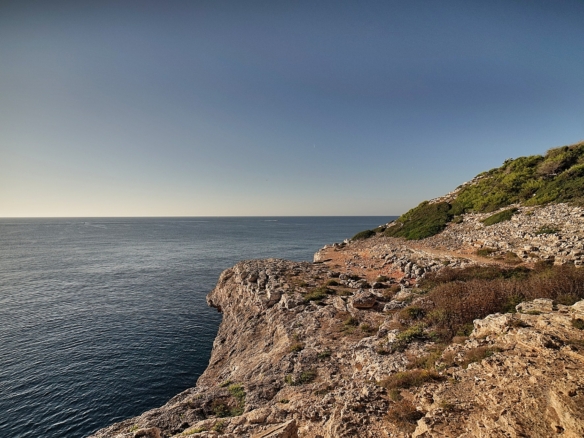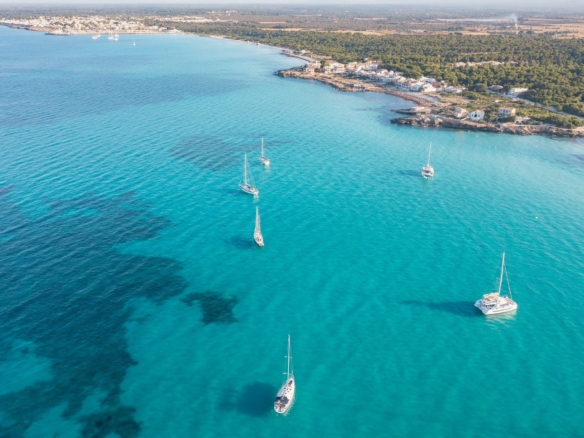

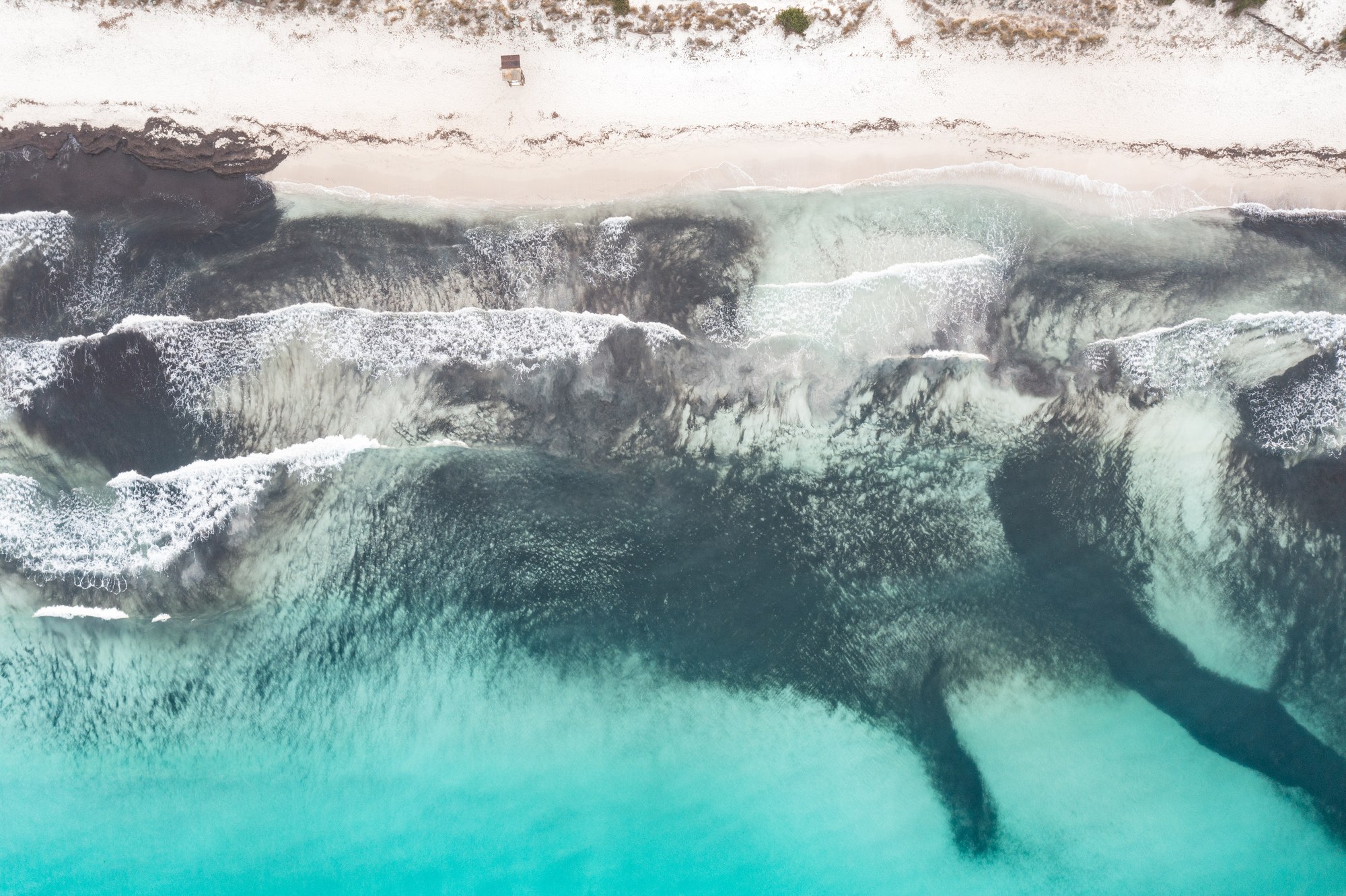
The short version: living near Es Trenc means choosing between four settings on the same stretch of Mallorca’s south coast. Sa Ràpita is a coastal community with a nautical club, two weekly markets and everyday services. Ses Covetes is a hamlet at the edge of the sand, with simple houses and almost no services. Colònia de Sant Jordi is a fishing harbor with sandy beaches and the boats to Cabrera. Behind them, the farmland between Campos and the sea holds country houses with land, five to ten minutes from the beach. This guide is about living there; for a day on the beach, see our guide to Es Trenc beach.
One shoreline, four ways of living
The Balearic government places the Es Trenc–Salobrar de Campos Maritime-Terrestrial Natural Park between the built-up area of Sa Ràpita, to the north-west, and Colònia de Sant Jordi, to the south-east; inland, the park is partly bounded by two country roads, the Ma-6104 and the Ma-6040 (Govern de les Illes Balears, natural parks).
That leaves the homes near Es Trenc in four groups: Sa Ràpita and Ses Covetes, in the municipality of Campos; Colònia de Sant Jordi, in Ses Salines; and the countryside behind the park, shared by both. To compare this coast with the rest of the island, our guide on where to live in Mallorca covers every area.
Sa Ràpita: the coastal town with everything close
Sa Ràpita sits at the far south-west of the Campos coast, on the border with Llucmajor. The town hall lists what it has today: restaurants, small local shops, a civic center, a sports center, tennis courts, playgrounds, a recycling point and the church of Santa Coloma. Markets are held on Wednesday and Saturday mornings in Plaça de ses Palmeres (Ajuntament de Campos; markets).
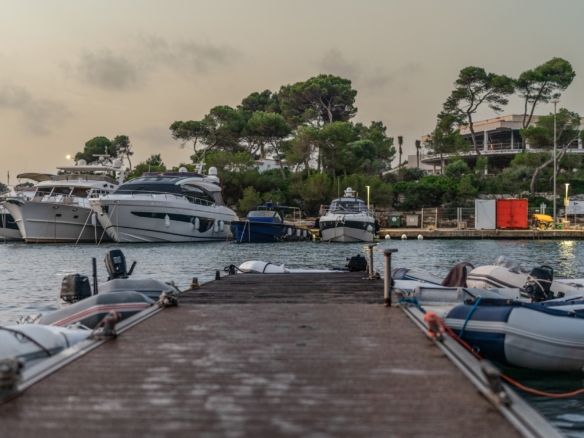
The Club Nàutic Sa Ràpita stands where the beach meets the rocky coast. According to the club, its sailing school runs all year for children and adults from the age of four, and the club also has a dry marina and a fishing section (Club Nàutic Sa Ràpita).
Sa Ràpita also has a basic health unit, part of the Campos health area, according to the Balearic health service (IB-Salut), and TIB bus lines L508 and L518. In what we see, it is the place on this coast where daily errands can be done on foot, with Es Trenc within walking distance along the shore.
Ses Covetes: a hamlet at the edge of the sand
Ses Covetes is the closest you can live to Es Trenc. The town hall describes it as a hamlet of Campos between Es Trenc and the beach of Sa Ràpita, born in the nineteenth century as a summer retreat for families from Campos and Porreres, with several restaurants today. It is one of the official entrances to the park and the start of its self-guided Ran de mar route along the shore to Colònia de Sant Jordi.
Ses Covetes is small, the houses are simple, and there are almost no services. For daily errands, residents drive to Sa Ràpita, about 11 minutes away, or to Campos, about 17.
Colònia de Sant Jordi: the harbor at the other end
At the south-eastern end of the park, Colònia de Sant Jordi is a fishing harbor with sandy town beaches. It is the closest Mallorcan port to the Cabrera Archipelago National Park, about ten nautical miles away, and tourist boats to the islands leave from here in the summer months (Govern de les Illes Balears, Cabrera). Es Carbó, a natural beach reached only on foot or by boat, is about 1 km away on foot (Illes Balears tourism agency).
Colònia has its own basic health unit and TIB line 517. We describe the harbor, its beaches and the bike lane to Ses Salines in our guide to Ses Salines and Colònia de Sant Jordi; Sa Ràpita and the town of Campos have their own in Campos and Sa Ràpita.
The countryside between Campos and the sea
Behind the coast lies the countryside. In the farmland between Campos and the beach, the homes are country houses with land: space, silence, often a pool, and Es Trenc five to ten minutes away by car. The park itself describes this landscape: farmland and livestock fields, generally privately owned, some of them still worked, alongside the salt works of the Salobrar.
A country house here works differently from a home in the village, and these are the practical questions we go through with every buyer:
- Water. Country houses usually rely on a cistern that collects rainwater and is topped up by tanker truck; the municipal network usually reaches only the houses next to a village. The water is hard, so a filter or softener is common.
- Electricity. Grid, solar panels or a generator: it is worth knowing which one a house uses.
- Access. Some houses are reached by asphalt, others by a dirt track; ask who looks after it.
- Internet. Fiber does not reach every plot, and on some country houses owners use satellite internet.
Living next to a natural park
What the park’s official page says about using it applies to residents as much as to visitors. Entry is free and the park is open around the clock. The areas open to the public are the beaches along the shore and the public paths; walking behind the line of dunes or across private land requires permission. Dogs may go on the beach from November to February, on a leash, and not at all from March to October. The park is a high fire-risk area, and fires are never allowed.
The park also organizes family activities on weekends, announced on its social media channels and by email to those on its mailing list, along with guided visits at different times of the year. Its management office is in Campos, open on weekdays from 8 am to 3 pm. The rules for a day on the beach itself, from parking to rubbish, are in our Es Trenc beach guide.
Summer and winter by Es Trenc
In summer, the roads down to Ses Covetes and Sa Ràpita carry the beach traffic, the paid car parks fill early in the morning, and traffic and parking are what residents notice most. In winter, the silence is total: the beach belongs to walkers and the countryside is quiet day and night.
The climate follows the sea. The town hall describes the coast of Sa Ràpita as windy and dry, with around 400 mm of rain a year, warmer at night than the inland plain and milder in summer thanks to the sea breeze known locally as the embat. In winter, the south-westerly llebeig brings the biggest storms.
Getting around
Driving times below come from OpenStreetMap routing, in free-flowing traffic:
- Sa Ràpita to Ses Covetes: about 11 minutes (5.8 km).
- Ses Covetes to Colònia de Sant Jordi: about 22 minutes (13.6 km), because the road runs inland around the park.
- To Campos: about 13 minutes from Sa Ràpita, 17 from Ses Covetes and 18 from Colònia.
- Colònia to Ses Salines: about 9 minutes.
- To Palma airport: about 37 minutes from Sa Ràpita, 42 from Ses Covetes and 44 from Colònia.
- To central Palma: about 39 minutes from Sa Ràpita, 44 from Ses Covetes and 45 from Colònia.
Outside Sa Ràpita and Colònia, a car is part of daily life.
Who we see buying near Es Trenc
For the countryside between Ses Salines and Campos, which includes the farmland behind the park, the buyers we see are those looking for a village house or a country house with land: many of them German, Swiss, or Americans who work remotely.
What nobody tells you
Ses Covetes and Colònia de Sant Jordi share the same beach but not the same road: on foot, the shoreline joins them; by car, the drive goes inland and takes more than 20 minutes.
Rubbish works differently in the countryside. In the municipality of Campos, Sa Ràpita and Ses Covetes have door-to-door collection on a set calendar, while homes in the countryside use drop-off areas that are open 24 hours and accessed with an identification card requested in advance from the town hall (Ajuntament de Campos).
What you need to know
Can you live next to Es Trenc?
Yes. Sa Ràpita, Ses Covetes and Colònia de Sant Jordi are lived in all year, and country houses in the farmland behind the park are five to ten minutes from the beach.
What is the closest village to Es Trenc?
Ses Covetes, a small hamlet of Campos at the edge of the beach and one of the official entrances to the natural park. It has restaurants but almost no other services.
Does Sa Ràpita have shops and services all year?
Yes: restaurants, small shops, a civic and sports center, markets on Wednesday and Saturday mornings and a basic health unit.
How far is Es Trenc from Palma airport?
About 37 minutes from Sa Ràpita and 42 from Ses Covetes in free-flowing traffic, according to OpenStreetMap routing.
Is it quiet near Es Trenc in winter?
Very. In winter the beach belongs to walkers and the countryside is silent; summer brings traffic and full car parks.
Where we work
We work across Mallorca from our base in the south-east, a few minutes from Es Trenc, where you can browse homes in Santanyí, homes in Ses Salines and homes in Campos. Whether you are considering Sa Ràpita, Ses Covetes, Colònia de Sant Jordi or any other area of the island, contact Villas y Fincas Mallorca and we will answer in English.
Updated October 2026. Driving times come from OpenStreetMap routing and vary with traffic and season; facts about the natural park and Cabrera come from the Govern de les Illes Balears, those about Sa Ràpita, Ses Covetes, markets and waste collection from the Ajuntament de Campos, and the rest from IB-Salut, the Balearic tourism agency and the Club Nàutic Sa Ràpita, all consulted in October 2026. The descriptions reflect what we see with our clients and are for general information only.