
The short version: most houses in Mallorca do not have the single central system an American expects. In the homes we visit, heating and cooling are organized room by room, and the system you will meet most often is air conditioning with a heat pump: a wall unit in each room that cools in summer and heats in winter. Renovations and new builds usually have aerothermal heating, a heat pump that warms water for underfloor heating or radiators. Around them you will find fireplaces and wood stoves, pellet stoves, electric radiators, diesel boilers in older country houses and bottled gas. This guide explains each one in plain words and what it means for daily life.
Heating and cooling systems in Mallorca
Our guide to winter in Mallorca covers the climate and why a stone house can feel colder inside than out on a January evening. This guide goes system by system: what each one is, how it works and what living with it involves.
There is no standard. A renovated country house, a village house and a coastal apartment can each be heated in a different way, and many homes combine two or three systems.
Air conditioning with a heat pump: split units
This is what we see most often, in apartments, village houses and renovated country homes alike. In Spain it is called a split, and an American would call it a ductless mini-split: an indoor unit high on the wall of each room, connected by refrigerant pipes to an outdoor unit on a terrace, roof or patio. Each room has its own remote control and its own temperature.
According to the IDAE, Spain’s Institute for Energy Diversification and Saving, a heat pump is a thermal machine that pumps heat from a cold source to a warm one. An air-source heat pump takes heat from the outside air and transfers it into the building; if it is reversible, the cycle is inverted and the heat is taken out of the building instead. The IDAE adds that the most widespread models are electrically driven. In everyday terms: the same unit that keeps a bedroom cool in August keeps it warm in January, and you choose the mode on the remote.
Aerothermal heating: underfloor heating or radiators
“Aerothermal” is the word you will read in almost every listing of a renovated house, and it sounds more complicated than it is. The IDAE defines aerothermal energy as the energy stored in the form of heat in the ambient air, and the European renewable energy directive, Directive (EU) 2018/2001, counts this ambient energy as renewable, while noting that heat pumps need electricity or other auxiliary energy to work.
The difference from a split is where the heat goes. An aerothermal system is also a heat pump with an outdoor unit, but instead of blowing warm air into a room it heats water, which then circulates through pipes under the floor, the suelo radiante, or through radiators. With underfloor heating there is nothing on the walls: the floor itself is the heater. In what we see in Mallorca, aerothermal heating with underfloor pipes is the usual choice in thorough renovations and in new builds, because the floors are already being lifted or laid.
You may also read about geothermal heating. It works on the same principle, but the heat pump takes its heat from the ground rather than the air, through pipes buried in the land, as the IDAE explains on its geothermal page.
Fireplaces and wood-burning stoves
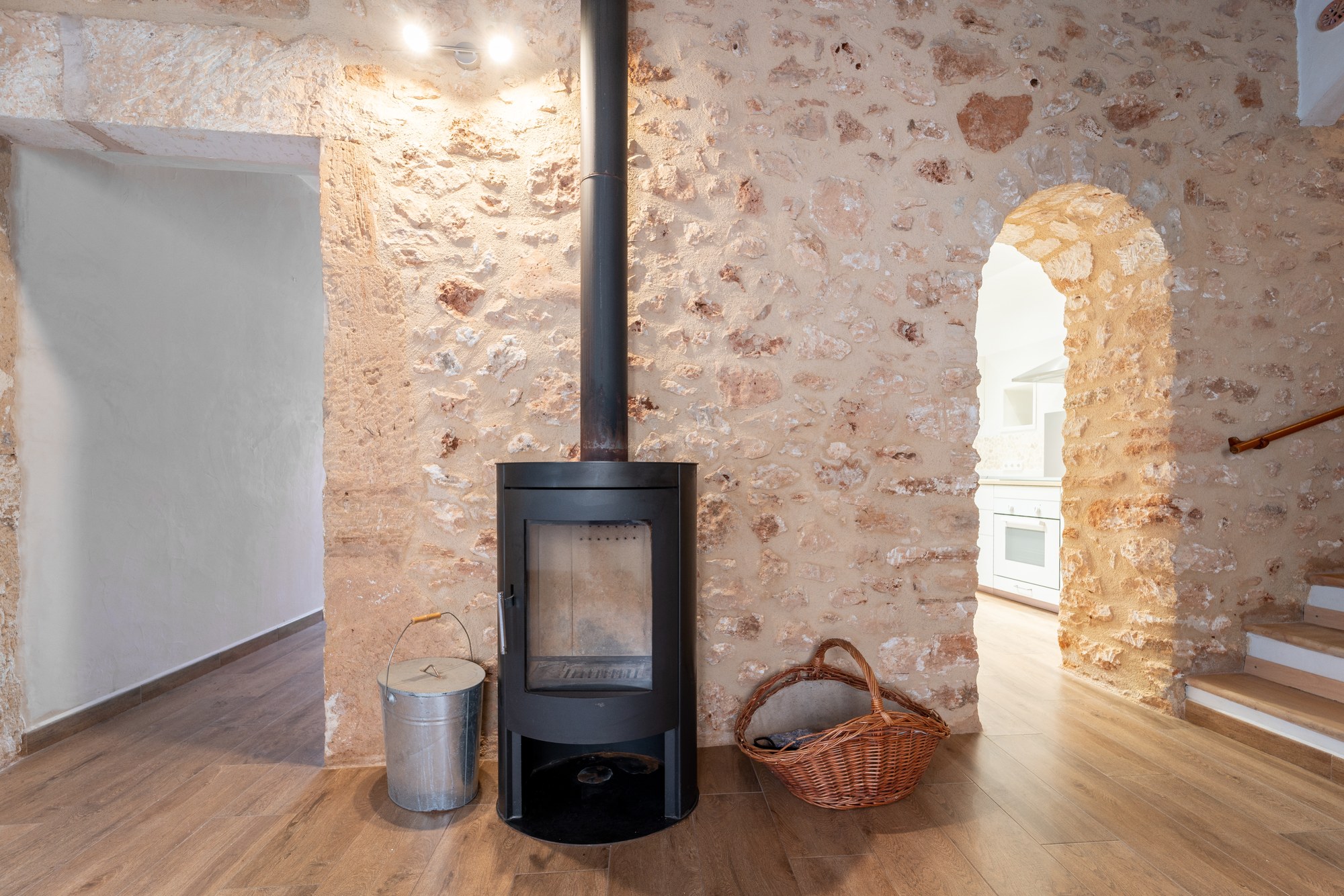
In older houses, the fireplace, chimenea, or the cast-iron wood stove, estufa de leña, is still the heart of the living room in winter. The IDAE’s page on biomass describes firewood as the least processed wood fuel, used in domestic stoves and fireplaces and traditionally burned in single-family homes. It also makes a distinction worth keeping in mind: stoves and fireplaces heat the room they are in, while a boiler can provide heating and hot water for the whole house at the same time.
Living with a wood fire means having somewhere dry to keep the logs, cleaning out the ash and lighting it by hand.
Pellet stoves
The pellet stove, estufa de pellets, looks like a modern wood stove but burns a different fuel. The IDAE describes pellets as the most processed wood fuel: small cylinders 6 to 12 mm in diameter, made of compressed sawdust, wood chips or other residues. Like a log stove, a pellet stove heats the room it stands in; a pellet boiler can serve radiators or underfloor heating for the whole house. The pellets come in bags, so a dry storage spot near the stove is part of the picture.
Electric radiators, diesel boilers and bottled gas
There are three more systems to know:
- Electric radiators. They are either wall-mounted or portable.
- Diesel boilers with radiators. Known as gasoil heating, they are found in older country houses, especially those far from the village.
- Bottled gas. Butane or propane in cylinders, the bombonas, is still part of daily life in some homes: for the stove, the water heater or a portable gas heater.
Damp, stone walls and orientation
How warm a house feels depends as much on the building as on the machine.
Orientation and the patio: in a village house, light and coolness depend on them, and main rooms that get the low winter sun feel visibly warmer, as our guide to casas de pueblo, the Mallorcan village houses, explains. The walls: signs of moisture at the base of walls and in rooms with little ventilation.
For Americans: what works differently here
Compared with a typical American home:
- No standard central heating. A single furnace with ducts to every room is not the norm. Ask what heats each room, not whether the house has heating.
- A thermostat per room. With splits, every room has its own remote; with underfloor heating, there is often a thermostat on the wall of each room or zone.
- The January chill indoors. A house left closed for weeks in winter takes time to feel lived in again; the winter guide explains why.
Whether a system can be added or changed in a specific house is for the architect or installer who looks at it.
Buying a house and energy grants
Our guide to buying a house in Mallorca as an American explains how the whole process works with us.
Grants for renewable energy and energy efficiency in homes exist, with calls that change from year to year, so this guide gives no amounts. They are published by the IDAE for national programs and by the Balearic government’s Directorate General for Energy and Climate Change.
What you need to know
Do houses in Mallorca have heating?
Most do, but rarely as one central system. In what we see, the most common is air conditioning with a heat pump, which heats as well as cools, combined in many homes with a fireplace, a wood or pellet stove or electric radiators.
Do houses in Mallorca have central heating?
Some do: renovations and new builds often have aerothermal underfloor heating, and older country houses may have radiators fed by a diesel boiler. Many older homes are heated room by room.
What is aerothermal heating?
An electric heat pump that takes heat from the outside air, which the IDAE calls aerothermal energy, and uses it to heat water for underfloor heating or radiators. Reversible systems can also cool.
Does air conditioning in Mallorca also heat?
Usually, yes. The split units we see in most homes are heat pumps: the IDAE explains that a reversible heat pump inverts its cycle, so the same unit cools in summer and heats in winter.
Are there grants for heat pumps or pellet stoves?
Calls for renewable energy and efficiency grants exist and change every year. They are published by the IDAE and by the Balearic government’s Directorate General for Energy and Climate Change.
Where we work
We work across Mallorca from our base in the south-east, and these are the villages where we work every day: homes in Santanyí, homes in Ses Salines and homes in Campos. To compare areas, our guide on where to live in Mallorca covers the whole island. If you would like to see how a house is heated before you decide, contact Villas y Fincas Mallorca and we will answer in English.
Updated October 2026. The technical descriptions come from official sources consulted in October 2026: the IDAE pages on aerothermal energy, geothermal energy and biomass, and Directive (EU) 2018/2001. Where grants are published comes from the IDAE and the Govern de les Illes Balears. The systems found in homes reflect what we see with our clients in Mallorca. This guide is for general information only and is not technical advice: each installation is defined by a qualified professional.