
The short version: everything measured in Mallorca is metric, and six conversions cover most of daily life: kilometers on the road, kilometers per hour on the signs, liters at the pump, kilos at the market, square meters in a house and degrees Celsius in the forecast and the oven. The factors are published by the U.S. National Institute of Standards and Technology; the examples are from the island, with distances measured on its roads, speed limits taken from Spain’s traffic regulations and temperatures from the national weather agency, AEMET.
The factors behind every conversion
Every conversion below rests on the factors in Appendix B.8 of the NIST Guide to the SI, the reference the U.S. government publishes for converting between customary and metric units. Five of them are enough for this story, each with the shortcut that gets you close without a calculator:
- Distance: 1 mile is 1.609 kilometers, so kilometers times 0.62 gives miles.
- Volume: 1 U.S. gallon is 3.785 liters, so liters divided by 3.8 gives gallons.
- Weight: 1 pound is 0.4536 kilograms, so kilos times 2.2 gives pounds.
- Area: 1 square foot is 0.0929 square meters, so square meters times 10.8 gives square feet.
- Temperature: Fahrenheit is Celsius times 9/5 plus 32; as a shortcut, double the Celsius number and add 30.
The rest of the story applies them to things you will actually meet. The conversions are arithmetic; the figures they are applied to carry their source.
Distances: kilometers on the road
Distances in Mallorca are in kilometers. Measured with OSRM, an open-source routing engine that works on OpenStreetMap data, the drive from the center of Palma to the center of Santanyí is about 52 kilometers, or 32 miles. The same measurement, made in October 2026 between the centers of the towns and rounded to the kilometer, gives these distances from Palma:
- Campos: about 39 kilometers, or 24 miles.
- Ses Salines: about 51 kilometers, or 32 miles.
- Manacor: about 51 kilometers, or 32 miles.
- Santanyí: about 52 kilometers, or 32 miles.
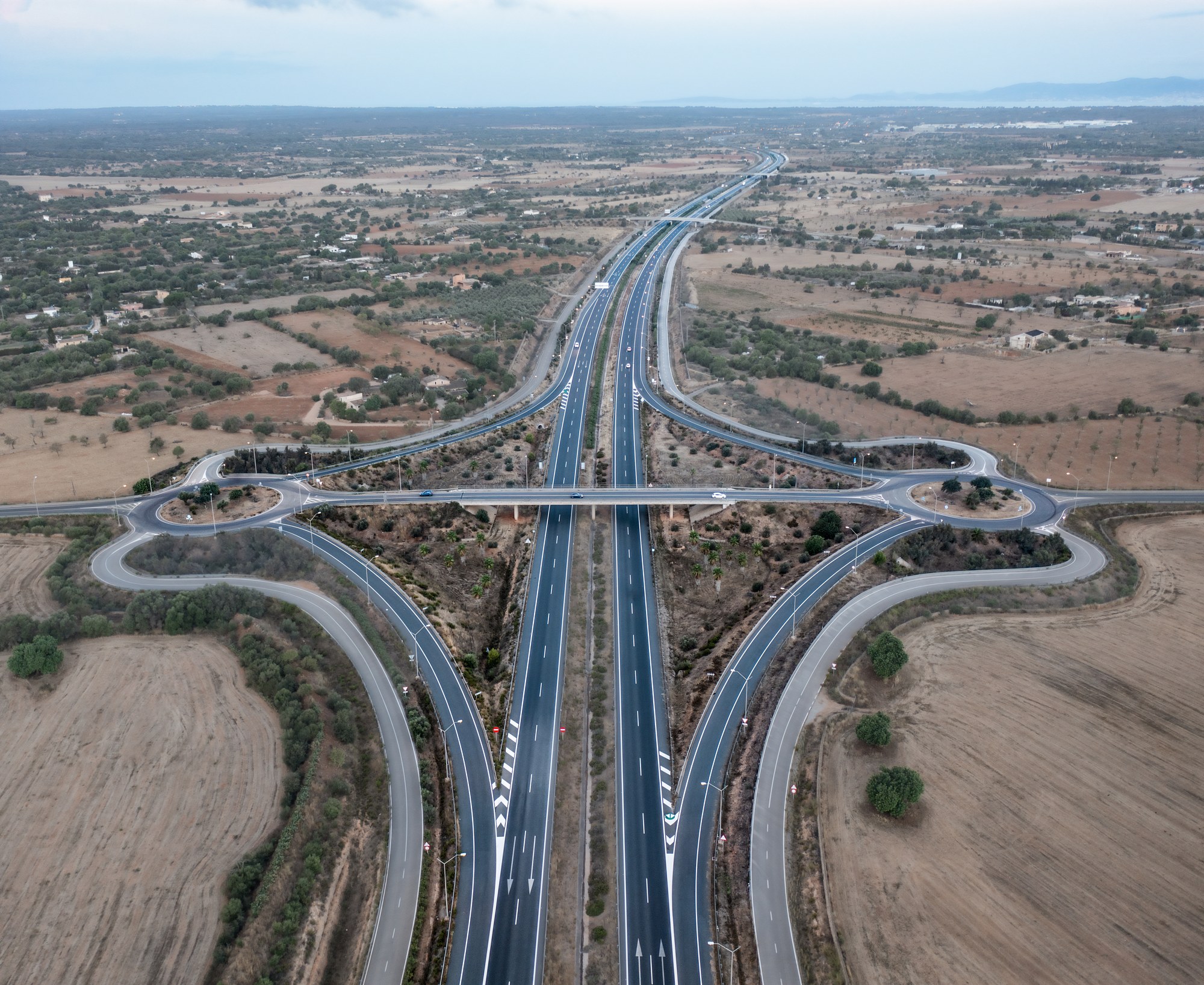
A router picks one route among several, so treat these as approximate. For the whole island, the Consell de Mallorca, which runs the roads, counts 205 roads that add up to 1,578.28 kilometers (981 miles). Of them, 201 are conventional roads, with 1,484 kilometers (922 miles), and 4 are high-capacity roads, with 94.6 kilometers (59 miles). The names of those roads, the Ma- codes, are in our story on ten words on Mallorcan road signs.
Speed: kilometers per hour on every sign
Speed limits are posted in kilometers per hour, and Spain sets general limits by type of road. For cars, Article 48 of the General Traffic Regulations fixes the general limit outside built-up areas at 120 km/h on autopistas and autovías, the motorways and high-capacity roads, and 90 km/h on conventional roads. Inside towns, Article 50 sets three general limits by street type, which the traffic authority, the DGT, announced when they came into force in May 2021. In miles per hour, using the factor of 0.62:
- 120 km/h is 75 mph: motorways and high-capacity roads.
- 90 km/h is 56 mph: conventional roads.
- 50 km/h is 31 mph: urban streets with two or more lanes in each direction.
- 30 km/h is 19 mph: urban streets with a single lane in each direction.
- 20 km/h is 12 mph: urban streets with a single platform for road and sidewalk.
These are the general limits; a sign can set a different one, and the municipal authority can lower the urban ones. This story explains units, not traffic rules, which are in the regulations and on the DGT’s page of basic rules for foreign drivers. If you arrive with a U.S. license, our guide on whether U.S. citizens must retake the driving test in Spain covers that question.
Temperature: Celsius in the forecast
AEMET publishes the climatological normals for each station. For Palma de Mallorca Airport, over the period 1981-2010, the monthly mean temperature is 9.5 °C in January and 24.8 °C in July. Converted with the formula above:
- The mean temperature in January: 9.5 °C is 49.1 °F.
- The mean of the daily minimums in January: 3.8 °C is 38.8 °F.
- The mean temperature in July: 24.8 °C is 76.6 °F.
- The mean of the daily maximums in August: 31.3 °C is 88.3 °F.
- The mean temperature over the whole year: 16.5 °C is 61.7 °F.
A few fixed points help more than any formula: 0 °C is 32 °F, 10 °C is 50 °F, 20 °C is 68 °F, 30 °C is 86 °F and 40 °C is 104 °F. Each ten degrees Celsius adds eighteen Fahrenheit. How those numbers feel against California and Florida is in our guide to the weather in Mallorca compared to California or Florida.
In the kitchen: the oven in Celsius
Recipes written here and the oven dials we see in homes are in degrees Celsius, so the same formula does the work in the kitchen. The temperatures that come up most:
- 160 °C is 320 °F.
- 180 °C is 356 °F.
- 200 °C is 392 °F.
- 220 °C is 428 °F.
The doubling shortcut is too rough for baking, which is why the exact formula, Celsius times 1.8 plus 32, is worth keeping on a note in the kitchen.
At the pump: liters, and consumption per 100 kilometers
Fuel is dispensed in liters, and a U.S. gallon is 3.785 of them. The amounts that come up most when you fill a tank:
- 10 liters is 2.6 gallons.
- 20 liters is 5.3 gallons.
- 40 liters is 10.6 gallons.
- 50 liters is 13.2 gallons.
- 60 liters is 15.9 gallons.
Consumption is the other half. In Europe a car’s efficiency is stated in liters per 100 kilometers, where lower is better, the reverse of miles per gallon. Combining the two factors above, miles per gallon equals 235.2 divided by the liters per 100 kilometers:
- 5 liters per 100 kilometers is 47.0 miles per gallon.
- 6 liters per 100 kilometers is 39.2 miles per gallon.
- 8 liters per 100 kilometers is 29.4 miles per gallon.
- 10 liters per 100 kilometers is 23.5 miles per gallon.
- 12 liters per 100 kilometers is 19.6 miles per gallon.
At the market: kilos and grams
At the village markets fruit, vegetables and cheese are sold by weight in kilos and grams, and a kilo is 2.205 pounds. The weights you will ask for most often:
- 1 kilo is 2.20 pounds.
- Half a kilo, 500 grams, is 1.10 pounds.
- 250 grams is 0.55 pounds, or 8.8 ounces.
- 100 grams is 3.5 ounces.
- 1 pound is 454 grams.
Which villages hold their market on which day is in our guide to meal times and tipping, and where residents of the south-east do their shopping is in where expats shop in south-east Mallorca.
Floor area: square meters to square feet
Homes are measured in square meters, and a square meter is 10.764 square feet. For a quick sense of scale:
- 50 square meters is 538 square feet.
- 80 square meters is 861 square feet.
- 100 square meters is 1,076 square feet.
- 150 square meters is 1,615 square feet.
- 200 square meters is 2,153 square feet.
Land has its own units. A hectare is 10,000 square meters, which is 2.47 acres, and a plot of 1,000 square meters is 10,764 square feet. One thing to know before comparing sizes: a Spanish listing can state built area, metros construidos, or usable area, metros útiles, and they are not the same number, which our guide on Spanish property sizes explains.
What you need to know
How do I convert kilometers to miles quickly?
Multiply by 0.62. The drive from Palma to Santanyí, about 52 kilometers, is about 32 miles.
What is 120 km/h in miles per hour?
About 75 mph. In the General Traffic Regulations, 120 km/h is the general limit for cars on autopistas and autovías, and 90 km/h, about 56 mph, on conventional roads.
How hot is 30 degrees Celsius?
It is 86 degrees Fahrenheit. AEMET’s normals for Palma Airport give 31.3 °C, or 88.3 °F, as the mean of the daily maximums in August.
How many liters are in a gallon?
A U.S. gallon is 3.785 liters, so a 40-liter fill is 10.6 gallons.
How many square feet are in a square meter?
10.764, so a 100-square-meter home measures 1,076 square feet.
Where we work
We work across Mallorca from our base in the south-east: homes in Santanyí, homes in Ses Salines and homes in Campos. For anything else, contact Villas y Fincas Mallorca and we will answer in English.
Updated October 2026. Conversion factors come from the NIST Guide to the SI, Appendix B.8; distances were measured with OSRM on OpenStreetMap data and road figures come from the Consell de Mallorca; speed limits come from Articles 48 and 50 of Spain’s General Traffic Regulations (BOE) and the DGT; temperatures come from AEMET’s climatological normals for Palma de Mallorca Airport, 1981-2010; all consulted in October 2026. The conversions are arithmetic, rounded as shown. This story explains units, not traffic rules, and is for general information only.