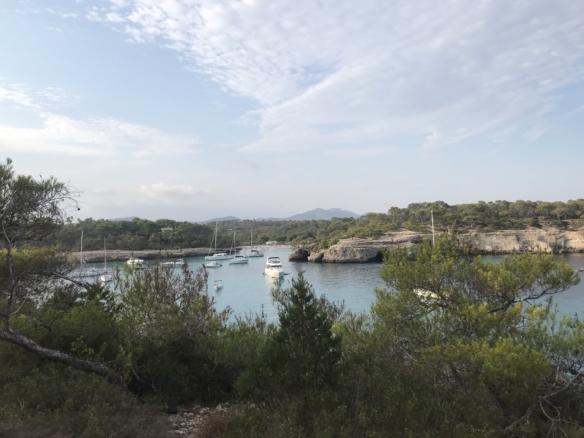

The short version: Cala Figuera and Cala Santanyí are two neighboring inlets on the south-east coast of Mallorca, in the municipality of Santanyí, six minutes apart by car and very different. Cala Figuera is a fishermen’s harbor in two narrow arms of sea, with boathouses at the water’s edge and no sandy beach: you come to walk, eat the fish of the day and watch the late light, ideally outside the high season. Cala Santanyí is a sandy family beach with lifeguards and services in summer. Between them, the rock arch of Es Pontàs is seen from a viewpoint beside the road, and many people stop there at sunset.
Two inlets, one arch
Three names come together on this short stretch of coast. Cala Figuera is a harbor and a small coastal hamlet. Cala Santanyí is a beach and the hamlet that grew around it. Es Pontàs is a rock arch standing in the sea, just south of Cala Santanyí. All three belong to Santanyí, at the south-eastern tip of the island.
If you picture a harbor as a marina full of yachts, Cala Figuera is the opposite: small boats, boathouses cut into the shore and homes stepping up the sides of the inlets. Cala Santanyí, for its part, is a single sandy cove between low cliffs. To compare areas of the island, our guide on where to live in Mallorca covers all of them.
Cala Figuera: a harbor in two arms of sea
The town hall describes Cala Figuera as a settlement formed by two small inlets, the caletes d’en Boira and d’en Busquets, already documented in 1306. Stone from Santanyí was shipped from here. The first building was a shed for boats, put up in the mid-19th century; the first house dates from 1899, the first church from 1938, and a small fish market and the quay were built in 1950. Since 1963, tourism has kept it growing (Ajuntament de Santanyí).
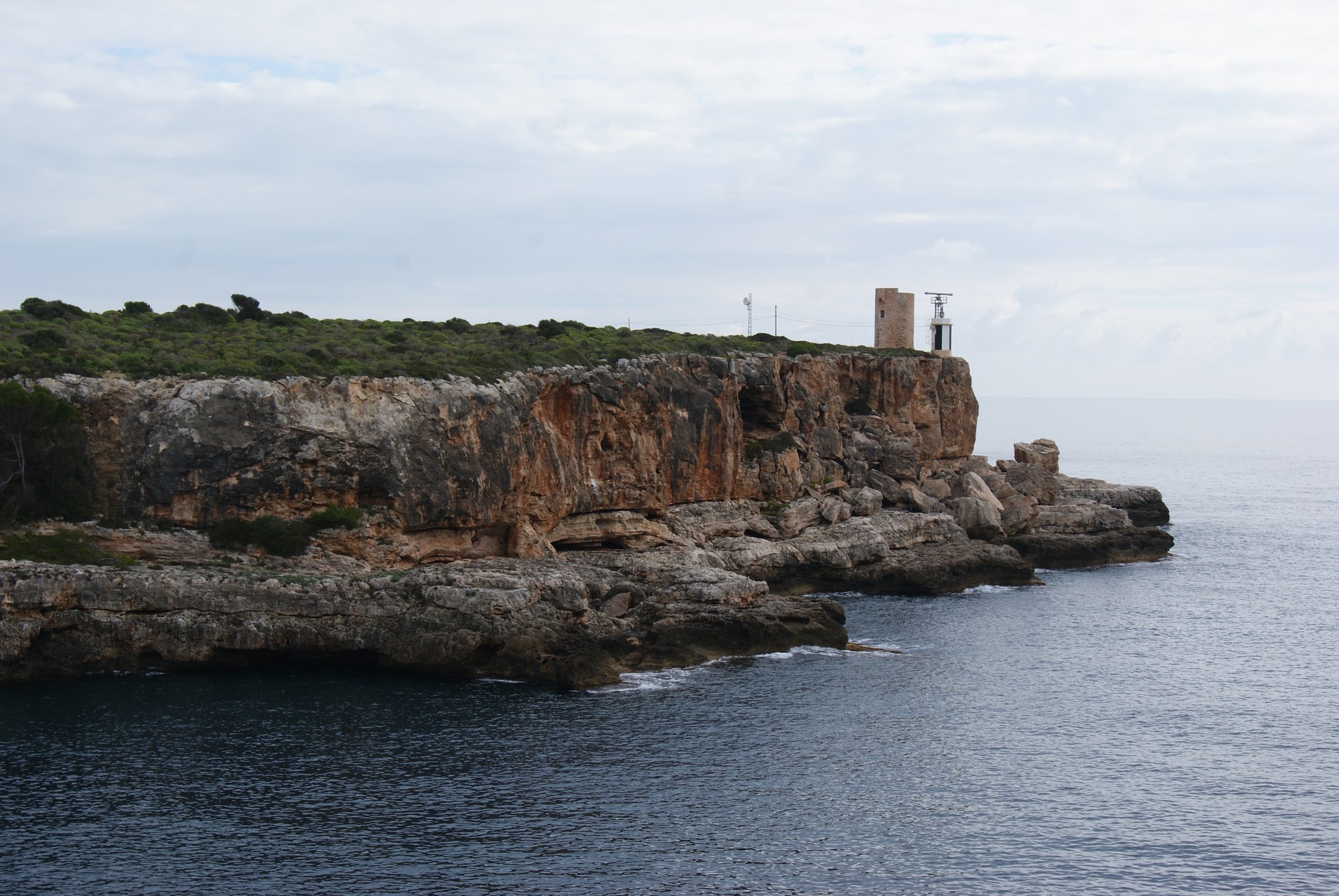
The coast here was also a line of defense. According to the town hall, the most important watchtowers of the municipality include the Torre d’en Beu at Cala Figuera, begun in 1569, one of a chain of towers that warned each other with bonfires (Ajuntament de Santanyí). The harbor still marks its own feast: on July 16, the Carme, a mass is followed by a procession at sea (Ajuntament de Santanyí).
No sand: the boathouses, the fish and the late light
Cala Figuera has no sandy beach, and in what we see it is not a place people come to swim. It is a harbor to walk. The path runs along the escars, the word Mallorquín uses for the fishermen’s boat shelters with their ramps, wooden props and roofs, where the small traditional boats, the llaüts, are kept (illesbalears.travel, Govern de les Illes Balears). The harbor restaurants serve the fish of the day.
The town hall calls the mouth of the harbor, the bocana, one of the most admired spots in the municipality, and began building a public viewpoint over it that anyone can reach comfortably (Ajuntament de Santanyí).
Our clients who know the area come at the end of the day and outside the high season, when the late light falls on the boats and the walk along the water is quiet.
Cala Santanyí: the sandy family beach
Cala Santanyí is the beach of this stretch of coast. The Balearic government’s tourism portal describes a deep bay with white sand, a beach about 70 meters long bordered by low cliffs, showers and lifeguards, bars and restaurants around it and a diving school on the beach; it places it 5.3 kilometers from the village of Santanyí (illesbalears.travel, Govern de les Illes Balears).
According to the town hall, in the 1920s there were a few houses and fishermen’s huts; development began in the 1960s; the first tourist business was a bar, and the first hotel went up in 1961. Today it is an important tourist area (Ajuntament de Santanyí). The past goes back much further: the town hall lists pre-Talayotic caves at Cala Santanyí and at Es Pontàs among the municipality’s archaeological sites (Ajuntament de Santanyí), and a 17th-century watchtower, the Torre Nova de sa Roca Fesa, stands on this side of the coast.
Lifeguards and services in season
The town hall includes Cala Santanyí in its lifeguard service: the 2018 contract in the official gazette covered Cala Santanyí, Cala Llombards, Cala Gran and sa Font de n’Alis–s’Amarador, for a season of at least May 1 to October 31, from 10 am to 6 pm and until 7:30 pm in July and August (BOIB, Ajuntament de Santanyí). In September 2024 the Cala Santanyí lifeguard team tested a rescue drone near Es Pontàs (Ajuntament de Santanyí). Each year’s service is set by the town hall.
Outside the season the services wind down, and the cove goes back to the people who live nearby.
Es Pontàs: the arch from the viewpoint
The town hall describes Es Pontàs as an islet that centuries of erosion have shaped into a bridge, a chance of nature that has inspired painters and artists for years. Professional and amateur climbers go up its walls, and several climbing films have been shot there; in 2017 the arch was the image on an ONCE lottery coupon (Ajuntament de Santanyí).
Most people see it from the viewpoint beside the road. The official tourism portal puts the walk from Cala Santanyí to the Es Pontàs viewpoint at about 800 meters (illesbalears.travel); by car it is about four minutes. Many people stop there at sunset.
Parking: up top, and only where it is allowed
In Cala Figuera, people park up top, in the upper part of the hamlet, and walk down to the harbor. The streets down by the water are where people live, and they are not a car park.
There is one rule our clients hear from us before anything else, here and at every cove of the south-east: never park in a residents-only area or anywhere illegal. If the spaces are full in August, come back another time.
Summer and winter
From May to October, Cala Santanyí works as a summer beach. Cala Figuera does not change its function with the season: it is a harbor in July and in January.
In what we see, both hamlets become very quiet outside summer, and that is when Cala Figuera shows its best side. At the edges of the season, check before counting on a restaurant. Santanyí, eight minutes inland, carries on all year with its school, health center, shops and market.
Getting there and getting around
Driving times below come from OpenStreetMap routing, from the harbor of Cala Figuera, in free-flowing traffic:
- Cala Santanyí: about 6 minutes.
- Santanyí: about 8 minutes.
- Es Llombards: about 11 minutes.
- Ses Salines: about 16 minutes.
- Cala Llombards: about 17 minutes.
- Campos: about 23 minutes.
- Cala d’Or: about 24 minutes.
- Palma airport: about 46 minutes.
- Central Palma (the cathedral): about 57 minutes.
From Cala Santanyí, the times to the airport and to Palma are about two minutes shorter. A car is part of everyday life.
Living near Cala Figuera and Cala Santanyí
In what we see, homes here fall into three groups: houses in Cala Figuera stepping up the sides of the inlets, some with the harbor below them; houses in the hamlet of Cala Santanyí, on the streets above the beach; and village houses in Santanyí or country houses with land between the villages, about ten minutes from the sea.
The profiles we see buying in this part of Mallorca are couples who work remotely, usually between 35 and 55, and buyers of a second home; in Santanyí itself, many are German buyers with high purchasing power. See also our guides to Santanyí, Cala Figuera and Es Llombards, Cala Llombards and Mondragó Natural Park.
What nobody tells you
There are three Cala Figueras in Mallorca. The official tourism portal warns not to confuse the one at Formentor with those of Calvià and Santanyí (illesbalears.travel). When you type it into a map, add Santanyí.
Do not bring a beach bag to Cala Figuera. Come for the walk and the fish, and swim at Cala Santanyí, six minutes away.
The town hall’s own tip for the arch is a boat. In its presentation of Es Pontàs, it says a guided boat visit is the way to enjoy it fully.
What you need to know
Can you swim at Cala Figuera?
It has no sandy beach; it is a fishermen’s harbor, for walking and the fish of the day. The nearest sandy beach is Cala Santanyí, about 6 minutes by car.
Is Cala Santanyí good for children?
It is the family beach of this coast: a deep bay with white sand, and lifeguards, showers and restaurants in season.
How do you get to the Es Pontàs viewpoint?
Beside the road just south of Cala Santanyí, about four minutes by car or 800 meters on foot from the beach.
Where do you park in Cala Figuera?
Up top, then walk down to the harbor. Never in residents-only areas or anywhere illegal.
When is the best time to visit Cala Figuera?
Our clients go at the end of the day and outside the high season.
Where we work
Cala Figuera and Cala Santanyí are part of our own corner of the island. We work across Mallorca from our base in the south-east, where you can browse homes in Santanyí, homes in Ses Salines and homes in Campos. Whatever area you are considering, contact Villas y Fincas Mallorca and we will answer in English.
Updated October 2026. Driving times come from OpenStreetMap routing and vary with traffic and season; other facts come from the Ajuntament de Santanyí, illesbalears.travel (Govern de les Illes Balears) and the Butlletí Oficial de les Illes Balears, consulted in October 2026. The descriptions reflect what we see with our clients and are for general information only.