
The short version: a casa de pueblo is the traditional Mallorcan village house: a home built wall to wall with its neighbors along the streets of a village center, with a stone or rendered façade on the street and, behind the front door, a patio or walled yard that passers-by never see. Inside you usually find timber-beamed ceilings, a ground floor and an upper floor, and often a top floor under the roof. Life in one is lived on foot, with neighbors close by. This guide explains what defines these houses, how they differ from a country house or an apartment, what to look at on a visit and where to find them.
What a casa de pueblo is
Casa de pueblo translates as “village house”, and in Mallorca it names a specific kind of home: one that stands in the historic center of a village, in a continuous row of houses sharing their side walls. Some façades are bare stone, others are rendered and painted; most have wooden shutters on the windows and balconies, and the front door opens straight onto the sidewalk, with no front yard in between.
It is not a townhouse in the American sense. It belongs to no planned development, and no two are alike: each has been built, extended and repaired by its owners over generations. Many look smaller from the street than they are: the frontage is narrow, but the house runs deep into the block.
Behind the façade, the layout repeats from village to village, with variations:
- The ground floor, with the entrance and the main living rooms.
- The patio or corral, the walled yard at the rear, traditionally the working space of the house.
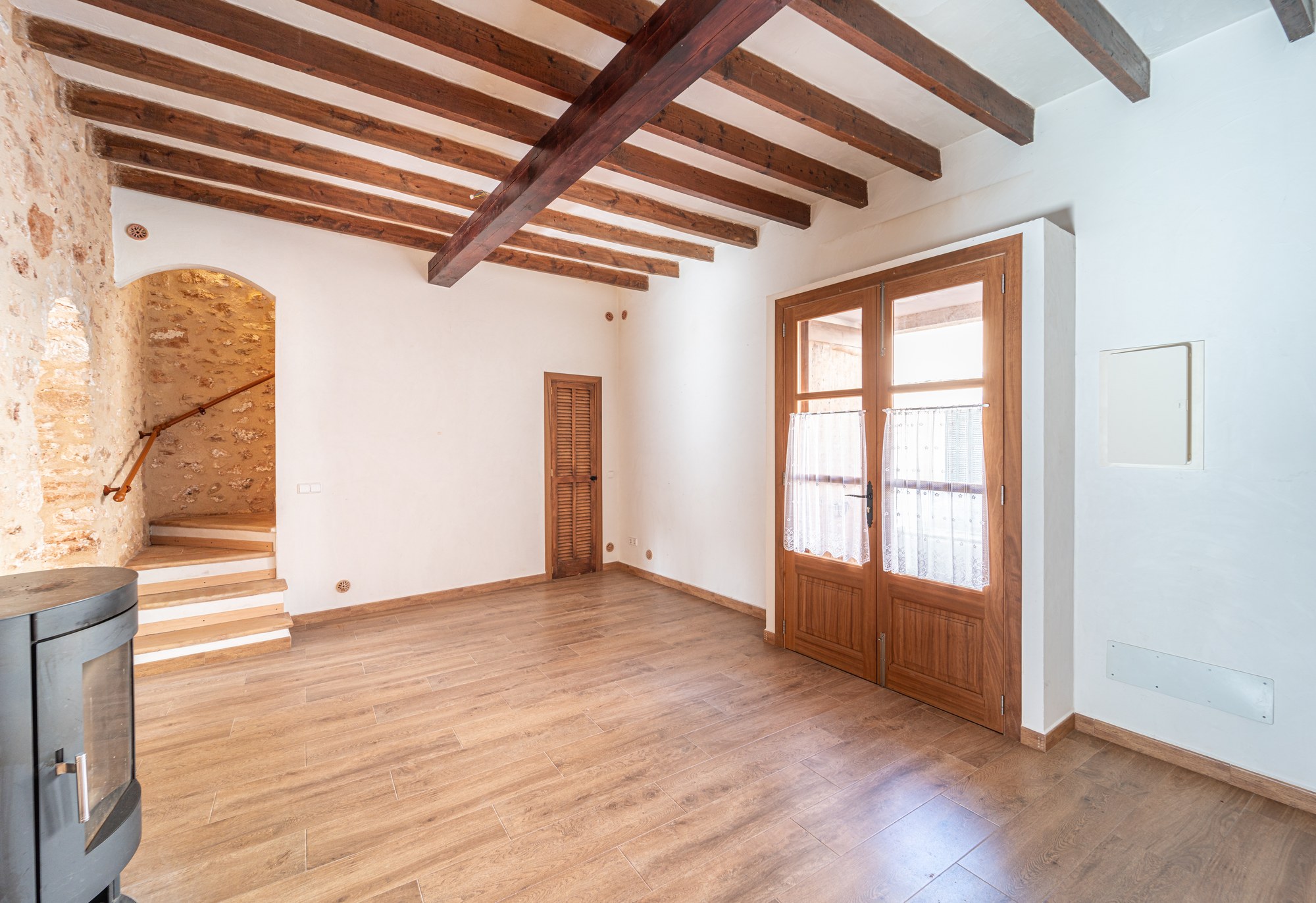
- The upper floor, with the bedrooms, and timber beams in many of the ceilings.
- The porxo, the top floor under the roof, which in many houses was used to store the harvest. Santanyí Town Council describes the same use in one of the village’s oldest buildings: the rectory on the main square has a spiral staircase leading up to the attic where the wheat collected as tithes was kept (Ajuntament de Santanyí).
- The terrace: many renovated houses gain one on part of the roof, looking over the rooftops.
How life works in a village house
A village house is the opposite of isolation. The bakery, the pharmacy, the bar on the square and the church are a short walk away, and daily errands are done on foot. In the south-east, where we live and work, the villages are lived in all year, with their schools, health centers and shops open in January as in July.
You also live wall to wall with your neighbors. That brings the sound of the street, voices on summer evenings, the church bells and the bustle of market day. It shapes the house itself: life here faces inward, toward the patio, rather than out to the street. For someone who wants complete silence, that is worth knowing before falling for a façade.
Two practical details: water comes from the municipal network and it is hard, so people drink bottled or filtered water and a water softener is common in village houses too. And what surprises our American clients most is parking: streets are narrow, many village centers have blue zones with time-limited parking, and a large car can be hard to place.
Village house, country house or apartment?
These three homes answer different questions. A country house in the south-east gives you land, silence and room for a pool, often about ten minutes from the sea, in exchange for using the car for everything; water there usually comes from a cistern that is refilled by tanker truck. An apartment gives you an elevator, a garage space and a community that looks after the pool and garden while you are away.
The village house sits in between in its own way: less outdoor space than a country house, more character than most apartments, and the village at your door. Its outdoor life happens in the patio and on the terrace.
What our buyers look at on a visit
When we visit village houses with clients, these are the points we look at together:
- Orientation and patio. Light and coolness depend on them. How much winter sun reaches the patio, and how much summer shade it keeps, defines how the house feels.
- Light at different hours. Narrow streets mean that the same room can be bright in the morning and dim in the afternoon, so a second visit at another time of day helps.
- Damp. Signs of moisture at the base of walls and in rooms with little ventilation, especially on the ground floor.
- Beams and façade. The condition of the timber beams in the ceilings, of the façade and of the roof.
- Stairs and access. Old staircases can be steep and narrow, which matters for furniture too.
- The street outside. Its noise on a weekend night and on market morning, and where you would park.
One more point that surprises Americans: in Spain there is no standard home inspection built into a purchase, so buyers who want the structure checked bring in an architect or surveyor of their own choosing before they commit.
Renovating: budget for time, and for craftsmen
Many village houses come with a renovation attached, small or large. Façades and beamed ceilings need care: old stone, thick walls and timber set their own pace, and the right way to treat them is rarely the fastest. The installations of an old house usually need bringing up to date as well. The owners who enjoy the process most budgeted time from the start.
The other resource to plan for is people. Craftsmen who work with stone and old timber are in demand across the island, and buyers who line them up early have an easier time.
Where to find casas de pueblo
Every village in Mallorca has its casas de pueblo. Here are some of them, listed from the south-east toward the center of the island, in no order of preference:
- Santanyí. The village of golden stone: the town council notes that its parish church, begun in 1786, was built with pedra de Santanyí, the local stone. Galleries, restaurants, life all year and a market on Wednesday and Saturday mornings on the Plaça Major (Ajuntament de Santanyí). See our guide to Santanyí, Cala Figuera and Es Llombards.
- Es Llombards. A small village in the municipality of Santanyí, close to Cala Llombards, with a market on Thursday mornings in the plaça des Pou, according to the same source.
- Ses Salines. A flat, quiet village that keeps the everyday rhythm of Mallorcan life, and where we are based; see our guide to Ses Salines and Colònia de Sant Jordi.
- Campos. A large, lively farming town with markets on Thursday and Saturday mornings (Ajuntament de Campos), described in our guide to Campos and Sa Ràpita.
- Felanitx. A large inland wine town, within the Pla i Llevant designation of origin, whose streets the Balearic tourism agency highlights for their traditional Mallorcan architecture (illesbalears.travel). Its weekly market is on Sundays, and the municipal food market opens Tuesday to Sunday mornings (Ajuntament de Felanitx).
- Porreres. Vineyards and almond trees around the village, and a historic center that is pedestrianized, according to the Balearic tourism agency.
- Algaida. A village with a farming tradition, well connected with Palma and with a market every Friday (illesbalears.travel); its countryside looks toward the Serra de Tramuntana.
- Sineu. In the center of the island, with old stately homes in its historic quarter and a Wednesday market that King Jaume II established in 1306 (illesbalears.travel).
In what we see, the south-east gives you more house and more land for the same budget than the south-west of the island. To compare these areas with the rest of Mallorca, our guide on where to live in Mallorca covers the whole island.
Who buys a village house
Among our clients in the south-east, the village house draws two profiles above all: couples who work remotely and want a real village around them all year, and buyers of a second home, many of them from Germany, Switzerland and the United States. Some look for a casa de pueblo from day one; others start with a country house in mind and find, on their first visits, that what they wanted was the square and the market.
What you need to know
What is a casa de pueblo in Mallorca?
A traditional house in a village center, sharing its side walls with the neighbors, with a stone or rendered façade, a patio or yard at the back and, often, timber-beamed ceilings.
What is the difference between a casa de pueblo and a country house?
The village house has neighbors, municipal water and daily life on foot. A country house stands on its own land outside the village, with space, silence, a cistern and the car for everything.
What should I look at when visiting a village house?
Orientation and patio, which decide light and coolness; signs of damp; the condition of the beams, façade and roof; the stairs; and the street outside, at night and on market day.
Where are casas de pueblo in Mallorca?
In every village. Some examples from the south-east and the center of the island: Santanyí, Es Llombards, Ses Salines, Campos, Felanitx, Porreres, Algaida and Sineu.
How long does it take to renovate a casa de pueblo?
Longer than most buyers expect: façades and beamed ceilings need care and good craftsmen are in demand, so it pays to budget time from the start.
Where we work
We work across Mallorca from our base in the south-east, where you can browse homes in Santanyí, homes in Ses Salines and homes in Campos. If you are looking for a village house anywhere on the island, contact Villas y Fincas Mallorca and we will answer in English.
Updated October 2026. Facts about Santanyí, Es Llombards, Campos and Felanitx and their markets come from the official websites of their town councils, and those about Felanitx, Porreres, Algaida and Sineu from the Balearic tourism agency, all consulted in October 2026. The descriptions reflect what we see with our clients and are for general information only.