
The short version: Pollença is the municipality at the northern tip of Mallorca, where the Serra de Tramuntana meets the sea, and it holds three very different places. Pollença town is an old inland village with the 365 steps of the Calvari and a market in Plaça Major every Sunday. Port de Pollença, ten minutes away, is a long, flat bay with a pine-shaded promenade and calm water for sailing. Formentor is the wild peninsula beyond, with its lighthouse, its beach and a road that closes to private cars in summer. This guide explains how each place lives, how far it is from Palma and the airport, and who buys there.
One municipality, three places
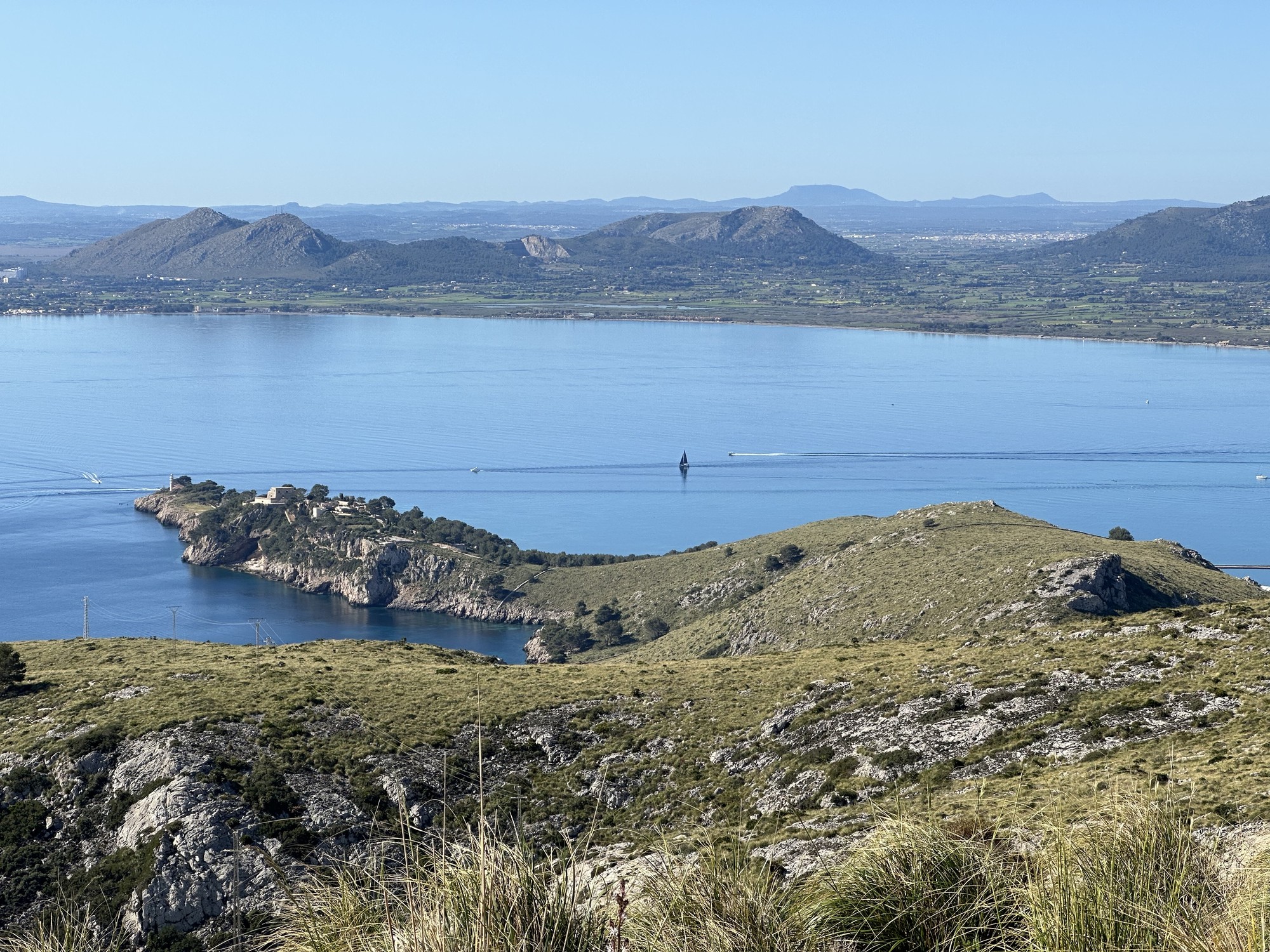
The municipality of Pollença sits at the northernmost end of Mallorca and of the Serra de Tramuntana, the mountain range listed by UNESCO as a World Heritage Site. According to the town hall, it has three urban centers: Pollença town, the administrative center; Port de Pollença, which locals call el Moll; and the small resort of Cala Sant Vicenç. Formentor, the peninsula that closes the bay to the north, is mostly natural land.
The town hall puts the population at 17,594 in 2024, around half in the town and 43 percent in the Port. It also notes that the mountains and the northern position give Pollença a microclimate slightly more humid and cooler than the rest of the island. Our guide on where to live in Mallorca places the north next to Palma and the south-east.
Pollença town: the Calvari, Plaça Major and the Sunday market
Pollença town keeps a street plan of medieval origin, with narrow lanes, and a social and cultural life that runs all year, in the town hall’s words. Its landmark is the Calvari: a stairway of 365 steps, one for each day of the year, flanked by cypress trees and fourteen crosses, climbing to a chapel with views over the town (Pollença tourist office). On Good Friday they are the setting for the Davallament, a silent, torchlit Easter ceremony.
Plaça Major was laid out between 1854 and 1857 and faces the parish church of Mare de Déu dels Àngels, founded in the 13th century. Every Sunday, from 9 am to 1:30 pm, the square and the neighboring Plaça de Ca les Monnares hold the weekly market, which the town hall says has taken place “since time immemorial” (Ajuntament de Pollença).
The homes are village houses on the narrow streets of the old town. In what we see, buyers come here for the life of a real Mallorcan town, with the square on foot and the beach ten minutes away.
Port de Pollença: the Pine Walk and a flat, calm bay
Port de Pollença is young. The town hall records that in 1860 a single fishing family lived there; a customs post opened in 1865, and by around 1900 the Port had about a hundred inhabitants. The town then grew in a long line facing the bay. Its best-known promenade is the Passeig Voramar, the Pine Walk, a narrow path between the water and the pines that runs toward the military airfield (Pollença tourist office).
The bay shapes daily life. The water is shallow and sheltered, and the tourist office describes it as an ideal setting for beginners in sailing, windsurfing and kayaking, with regattas organized every year by the Real Club Nàutic Port de Pollença. In what we see, this is a place for dinghy sailing rather than superyachts, and for families: the promenade is flat for strollers and bikes. The Port’s own market is on Wednesday mornings, from 9 am to 1:30 pm, and was officially created in 1984.
The writers who found it first
This coast drew artists long before mass tourism. The town hall dates the arrival of painters from outside the island to 1914, with Hermenegildo Anglada Camarasa, who lived in the Port and gave his name to one of its promenades. Miquel Costa i Llobera, Pollença’s best-known poet, was inspired by the headland to write his poem about the pine tree of Formentor. And Agatha Christie spent part of the summer of 1932 at Port de Pollença and set a short story there, Problem at Pollensa Bay, first published in 1935 (Ara Balears, 2026; Mallorca Magazin, 2020); the tourist office still mentions it when describing the beach.
The Hotel Formentor, opened in 1929 by the Argentine Adan Diehl as a place where artists could find inspiration, has hosted the Formentor literary conversations since 1959, a gathering of authors started by the Nobel laureate Camilo José Cela, according to the tourist office. Our guide to celebrities in Mallorca covers more names.
Formentor: the road, the lighthouse and the beach
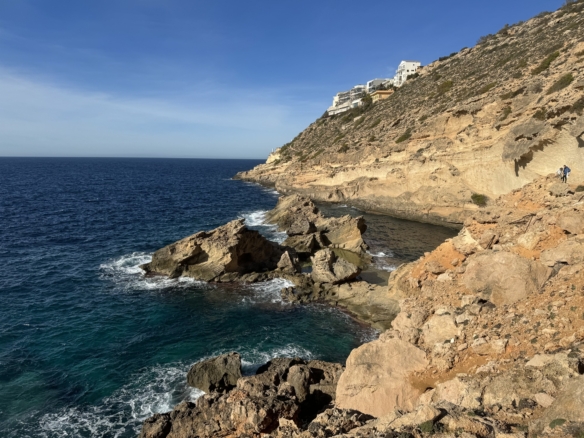
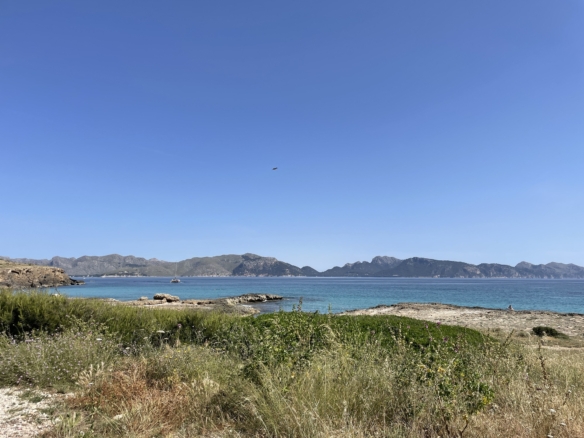
The Formentor peninsula is the last stretch of the Serra de Tramuntana. Its road, the Ma-2210, designed by the engineer Antonio Parietti, first reaches the Mirador des Colomer, a viewpoint built into the cliffs in 1961 at 232 meters above the sea. At the far end, the lighthouse opened in 1863 at 210 meters above sea level. Formentor beach, on the way, is a long, narrow strip of fine white sand where pines and holm oaks grow almost to the water.
In summer, access is regulated. For 2026, the Spanish traffic authority set the restriction from May 15 to October 18, from 10 am to 10 pm (DGT, Formentor 2026). Private cars may reach the beach car park until it is full; the lighthouse section is open only to authorized vehicles, TIB bus line 334, taxis, cyclists and hikers. The Consell de Mallorca says its 2018 pilot plan cut peak-hour traffic from 300 vehicles to 20 (Consell de Mallorca). In what we see, many also reach the beach by boat from Port de Pollença in summer.
How people who live here use Formentor
The moment residents talk about is sunrise at the lighthouse, but only on a dry day: humidity is the enemy of a clear dawn, and when the air is dry you can see Menorca on the horizon. In season, the road fills with cyclists and cars, so those who know it go at first light and come back before 10; under the 2026 rules, cars in the lighthouse section must leave by 9:59. At the beach, in what we see, the car park charges and fills early in summer, and people drive the curves calmly.
Summer and winter
In summer, the Port’s terraces are busy until late and the bay fills with small boats and sailing classes. In winter, in what we see, life is real but on a smaller scale: Pollença town keeps its shops, its Sunday market and its cultural life, and the Port, home to more than four in ten residents of the municipality, belongs to the people who live there all year.
Getting around: Palma, the airport and the bay
Driving times from OpenStreetMap routing, in free-flowing traffic:
- Pollença town: about 41 minutes to central Palma (52 km) and about 48 minutes to the airport terminal (60 km).
- Port de Pollença: about 50 minutes to central Palma (60 km) and about 57 minutes to the airport terminal (68 km).
- Pollença town to the Port: about 10 minutes.
- Port de Pollença to Formentor beach: about 15 minutes; to the lighthouse, about 26 minutes outside regulated hours.
Summer traffic adds time. For families, our guide to international schools in Mallorca lists every school on the official register.
Buyers in Pollença
The British have been coming to Pollença for decades, and the town hall confirms that people from the United Kingdom are today the largest foreign community in the municipality. By place:
- In Pollença town, buyers who want a village house and the life of the square, many of them British.
- In Port de Pollença, British families drawn by the flat promenade, the calm water and the sailing.
- In Pollença and Formentor, across the sector, well-known names who buy or rent here.
What nobody tells you
Distance is the first thing to weigh: for a home used all year, the drive to Palma and the airport becomes part of the routine. The second is Formentor in summer, when the road next door follows its own rules. The third is the climate the town hall describes, a little more humid and cooler than the rest of the island: pleasant in August, noticeable in winter.
What you need to know
How far is Pollença from Palma and the airport?
About 41 minutes to central Palma and about 48 minutes to the airport terminal in free-flowing traffic, by OpenStreetMap routing. Port de Pollença is about 50 and 57 minutes away.
How many steps does the Calvari in Pollença have?
365, one for each day of the year, flanked by cypress trees and fourteen crosses, according to the Pollença tourist office.
When is the market in Pollença?
Every Sunday from 9 am to 1:30 pm in Plaça Major and nearby streets. Port de Pollença has its own market on Wednesday mornings, at the same hours.
Can you drive to the Formentor lighthouse in summer?
Not by private car during regulated hours. In 2026, from May 15 to October 18, from 10 am to 10 pm, only authorized vehicles, the TIB bus 334, taxis, cyclists and hikers can use the lighthouse section; cars can reach the beach car park until it fills.
What is the Pine Walk in Port de Pollença?
The Passeig Voramar, a narrow seafront path shaded by pines that runs along the bay toward the military airfield.
Where we work
We work across Mallorca from our base in the south-east, where you can browse homes in Santanyí, homes in Ses Salines and homes in Campos. Whatever area you are considering, the north included, contact Villas y Fincas Mallorca and we will answer in English.
Updated October 2026. Driving times come from OpenStreetMap routing and vary with traffic and season; facts about the municipality, its population and its markets come from the Ajuntament de Pollença and its tourist office, and the Formentor traffic rules from the DGT and the Consell de Mallorca, all consulted in October 2026. Formentor’s rules are set each year and can change. The Agatha Christie reference was reported by at least two news outlets. The descriptions reflect what we see with our clients and are for general information only.