
The short version: Alcúdia sits on the north-east tip of Mallorca, on a peninsula between two bays, and it is really two places with one name. Alcúdia itself is a walled town of medieval origin, with a market on Tuesday and Sunday mornings and the remains of the Roman city of Pollentia at its gates. Port d’Alcúdia, a few minutes away, is the town on the bay: a long sandy beach, hotels, a marina and ferries to Menorca and Barcelona. Around them lie the wetland of s’Albufera and, facing the bay of Pollença, the quiet residential areas of Bonaire and Mal Pas.
Two places with one name
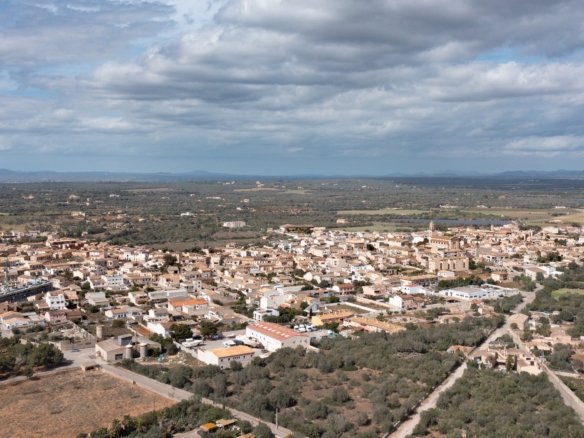
The municipality of Alcúdia covers a peninsula on the north-east coast of Mallorca, between the bay of Alcúdia to the south and the bay of Pollença to the north, according to the town hall. That peninsula holds three different ways of living. Inland is the walled town, whose name dates from the Muslim period and means “the hill”. On the bay of Alcúdia are the port and the long beach. And on the far side, looking toward Pollença, are Bonaire and Mal Pas, backed by the Victòria peninsula.
The old town and the port are about six minutes apart by road, by OpenStreetMap routing, so in daily life they work as one place. To compare this corner of the island with the rest, our guide on where to live in Mallorca covers every area, from Palma to the south-east.
The walled town
According to the town hall’s history of Alcúdia, King Jaume II ordered the town to be built, and work on its first ring of walls began in 1298 and was finished in 1362. Inside them, the streets kept a medieval layout, narrow and irregular (Ajuntament d’Alcúdia). The town and the archaeological site of Pollentia were declared a Historic-Artistic Site in 1963.
The tourism office describes the old town as a pedestrian maze inside 14th-century walls, with 26 towers and 16th-century bastions. A free walk along the top of the walls, the Camí de Ronda, looks over the rooftops and the bays. Of the original gates, the Porta del Moll faced the port and the Porta de Sant Sebastià the old road to Palma (Alcúdia tourism office).
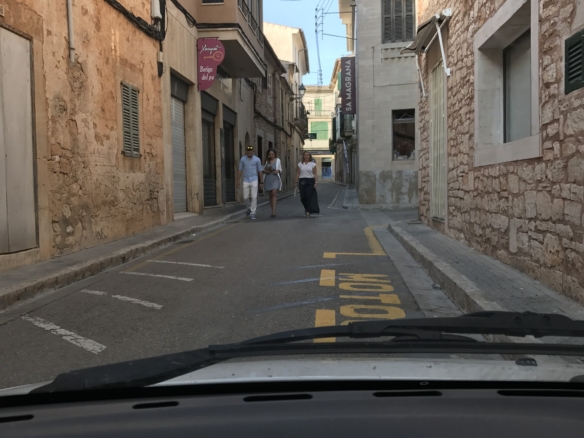
The homes inside the walls are town houses on those narrow streets, and the tourism office points to stately manor houses of the 16th and 17th centuries among them. Life in the old town is done on foot: the squares, the terraces and the shops are a few steps apart.
Market days
The weekly market fills the streets of the old town on Tuesday and Sunday mornings, and Port d’Alcúdia has its own on Friday mornings, in the Plaça de Cas Vicari, according to both the town hall and the tourism office (Ajuntament d’Alcúdia; Alcúdia tourism office). The two sources give slightly different opening times, so the safe rule is to go early and expect the stalls to pack up around lunchtime. Market day, shown in the video above, is when the old town is at its busiest.
Pollentia: the Roman city next door
A few meters from the walls lie the remains of Pollentia. According to the town hall, the Roman consul Quintus Caecilius Metellus brought Mallorca into the Roman Republic in 123 BC and founded Pollentia and Palma; the city prospered until the Vandals sacked it between 425 and 455. The tourism office adds that it became the capital of the whole archipelago, thanks to its position between the two bays (Alcúdia tourism office).
The visit covers three areas: the Sa Portella residential quarter, the forum and the theater, built in the 1st century AD with much of its seating carved into the rock. Inside the old town, near the church of Sant Jaume, the Monographic Museum of Pollentia occupies a 14th-century building and shows objects from the excavations, from kitchenware and jewelry to large sculptures (Ciutat Romana de Pollentia).
Port d’Alcúdia: the long beach, the hotels and the ferries
Port d’Alcúdia lives facing its beach. The tourism office describes Platja d’Alcúdia as fine white sand with calm, clear water and a very gentle slope, with beach services and a free entertainment program for adults and children from June to September (Alcúdia tourism office). The sand runs for several kilometers along the bay.
Behind the beach stand the hotels. The town hall’s history explains that large-scale tourism arrived here in the 1970s, with hotel complexes built partly on drained wetland. The beachfront is the busiest part of the municipality in summer.
The port is also a working harbor. Ports de Balears, the port authority, describes a commercial dock alongside a fishing quay and a marina, with passenger traffic to Menorca and to mainland ports (Ports de Balears). The operators list sailings from Alcúdia to Barcelona and to Ciutadella and Maó in Menorca (Trasmed).
Bonaire and Mal Pas: the quiet side
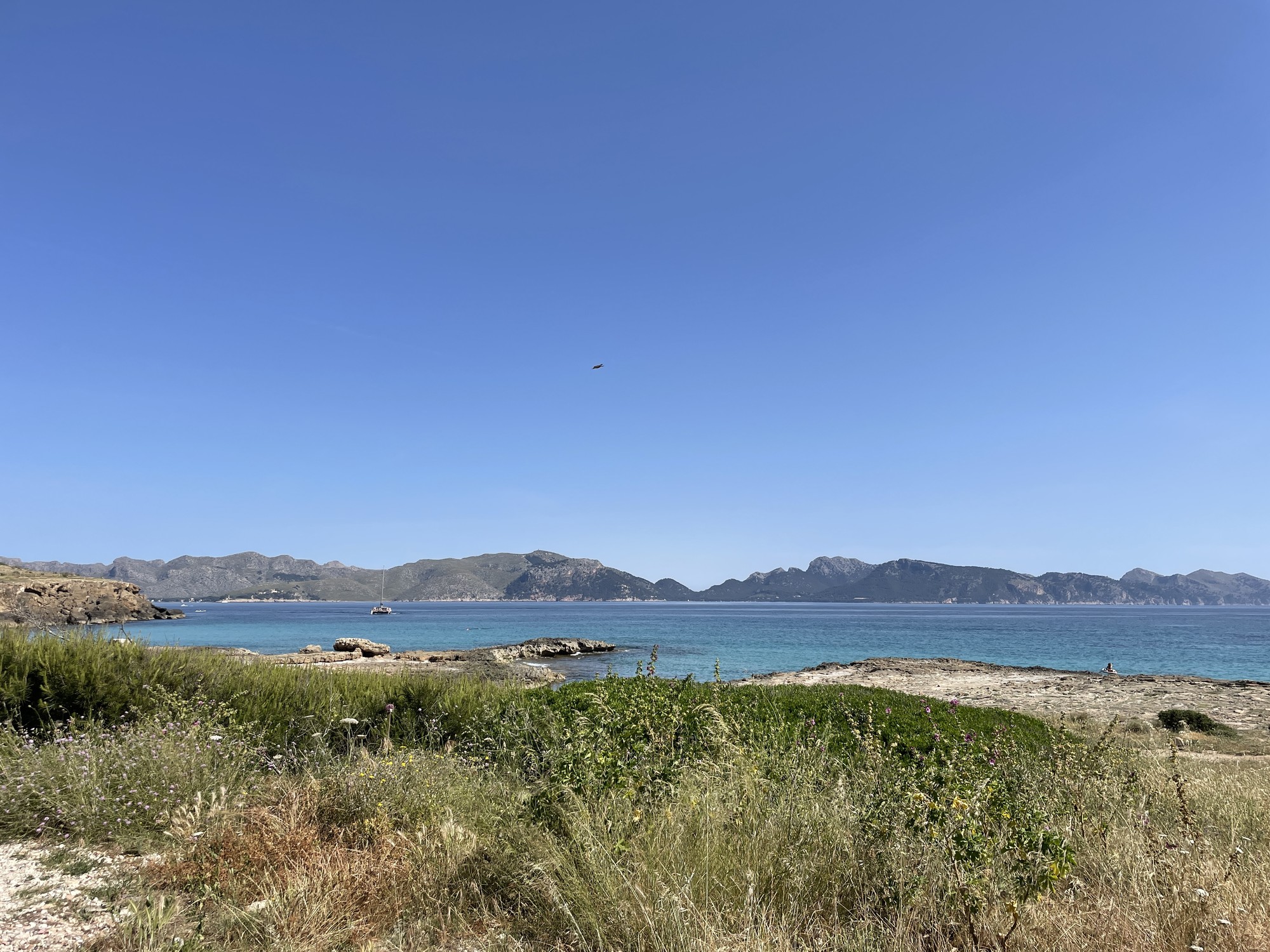
On the other side of the old town, facing the bay of Pollença, are Bonaire and Mal Pas, quiet residential areas with views across the water toward Pollença. This is the calm side of Alcúdia, away from the beachfront and about nine minutes from Bonaire to the old town by OpenStreetMap routing.
Nearby are the small beaches of Sant Joan and Sant Pere, which the tourism office describes as two almost identical sandy beaches opening onto the bay of Pollença (Alcúdia tourism office). Behind them rises the Victòria peninsula, with its hermitage and the Talaia de la Victòria lookout, at 445 meters the highest point in the municipality.
S’Albufera: the wetland, the birds and the bike
South of Port d’Alcúdia, just past the municipal boundary, begins s’Albufera de Mallorca. The Balearic Government describes it as the largest wetland in the Balearic Islands, 2,036 hectares in the municipalities of Muro and sa Pobla, declared a Natural Park on January 28, 1988, and listed under the Ramsar convention. Access is on foot or by bicycle over the Pont dels Anglesos (Govern de les Illes Balears). In October 2026 it was closed for path works until November 2; its page announces any closure.
For residents, s’Albufera is about nine minutes by car from the port. The tourism office counts more than 200 bird species across the area’s protected spaces, including s’Albufereta Nature Reserve on the Pollença side. The other face of so much water is humidity, part of daily life near the wetland.
Getting around: Palma, the airport and the north
Driving times below come from OpenStreetMap routing, to central Palma (Plaça d’Espanya, by the intermodal station) and to the airport terminal, in free-flowing traffic:
- Alcúdia old town: about 41 minutes to central Palma and about 46 to the airport.
- Port d’Alcúdia: about 41 minutes to central Palma and about 47 to the airport.
- Mal Pas: about 46 minutes to central Palma and about 58 to the airport.
- Bonaire: about 48 minutes to central Palma and about 53 to the airport.
In daily practice, with normal traffic, the drive to Palma or the airport is close to an hour, and that weighs on anyone planning to live here all year. Public buses (TIB) link Alcúdia with the station at Plaça d’Espanya in Palma, according to the tourism office and the town hall. The tourism office lists a health center in Alcúdia and a primary care unit in Port d’Alcúdia. For families, our guide to international schools in Mallorca lists every school with its location and official details.
Who lives in Alcúdia
Alcúdia has no typical buyer: its three areas attract different lives. What the people who settle here share is a choice: the beach, the bays and a walled town with a real daily life, in exchange for being farther from Palma and the airport than in many other areas of the island.
What nobody tells you
The hour matters more than the map suggests. Forty minutes to Palma in free-flowing traffic becomes close to an hour on a normal day, and a weekly trip to the airport or to a school in Palma adds up over a year.
The same municipality can feel like three places. The port in August, the old town on a winter Tuesday and a street in Bonaire in the evening have little in common. And the wetland brings humidity, worth noticing in a home in winter.
What you need to know
What is the difference between Alcúdia and Port d’Alcúdia?
Alcúdia is the walled town; Port d’Alcúdia is the coastal town on the bay, with the beach, hotels, marina and ferry port, about six minutes away by road.
How far is Alcúdia from Palma and the airport?
About 41 minutes to central Palma and about 46 to the airport in free-flowing traffic, by OpenStreetMap routing. With normal traffic, it is close to an hour.
When is the market in Alcúdia?
On Tuesday and Sunday mornings in the old town, and on Friday mornings in Port d’Alcúdia, in the Plaça de Cas Vicari, according to the town hall and the tourism office.
Are there ferries from Alcúdia to Menorca and Barcelona?
Yes. The port of Alcúdia has sailings to Ciutadella and Maó in Menorca and to Barcelona; timetables change by season.
Where are the quieter areas of Alcúdia?
Bonaire and Mal Pas, on the side of the peninsula facing the bay of Pollença: residential areas with views over the bay, about nine minutes from the old town.
Where we work
We work across Mallorca from our base in the south-east, where you can browse homes in Santanyí, homes in Ses Salines and homes in Campos. Whatever area you are considering, the north included, contact Villas y Fincas Mallorca and we will answer in English.
Updated October 2026. Driving times come from OpenStreetMap routing and vary with traffic and season; other facts come from the Ajuntament d’Alcúdia, its tourism office, the Roman City of Pollentia, the Govern de les Illes Balears, Ports de Balears and the ferry operators, consulted in October 2026. The descriptions reflect what we see with our clients and are for general information only.