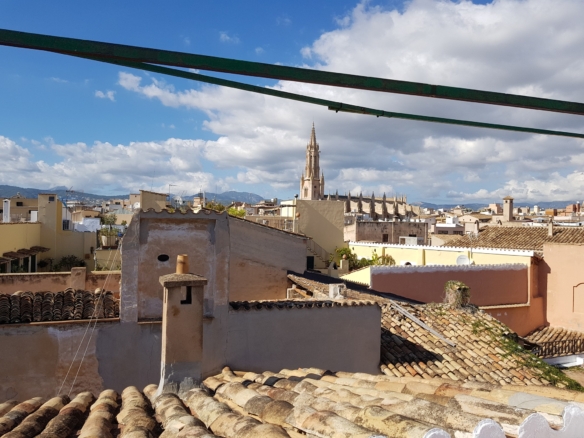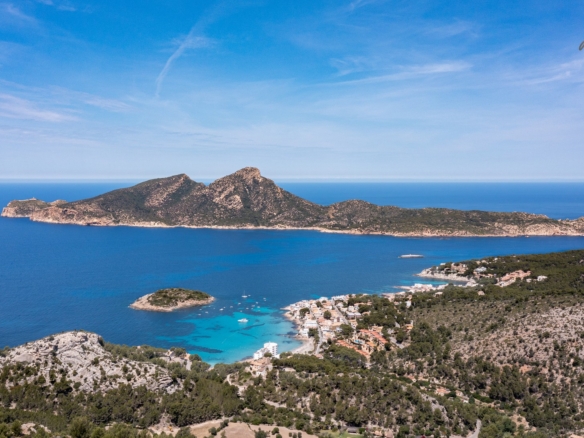

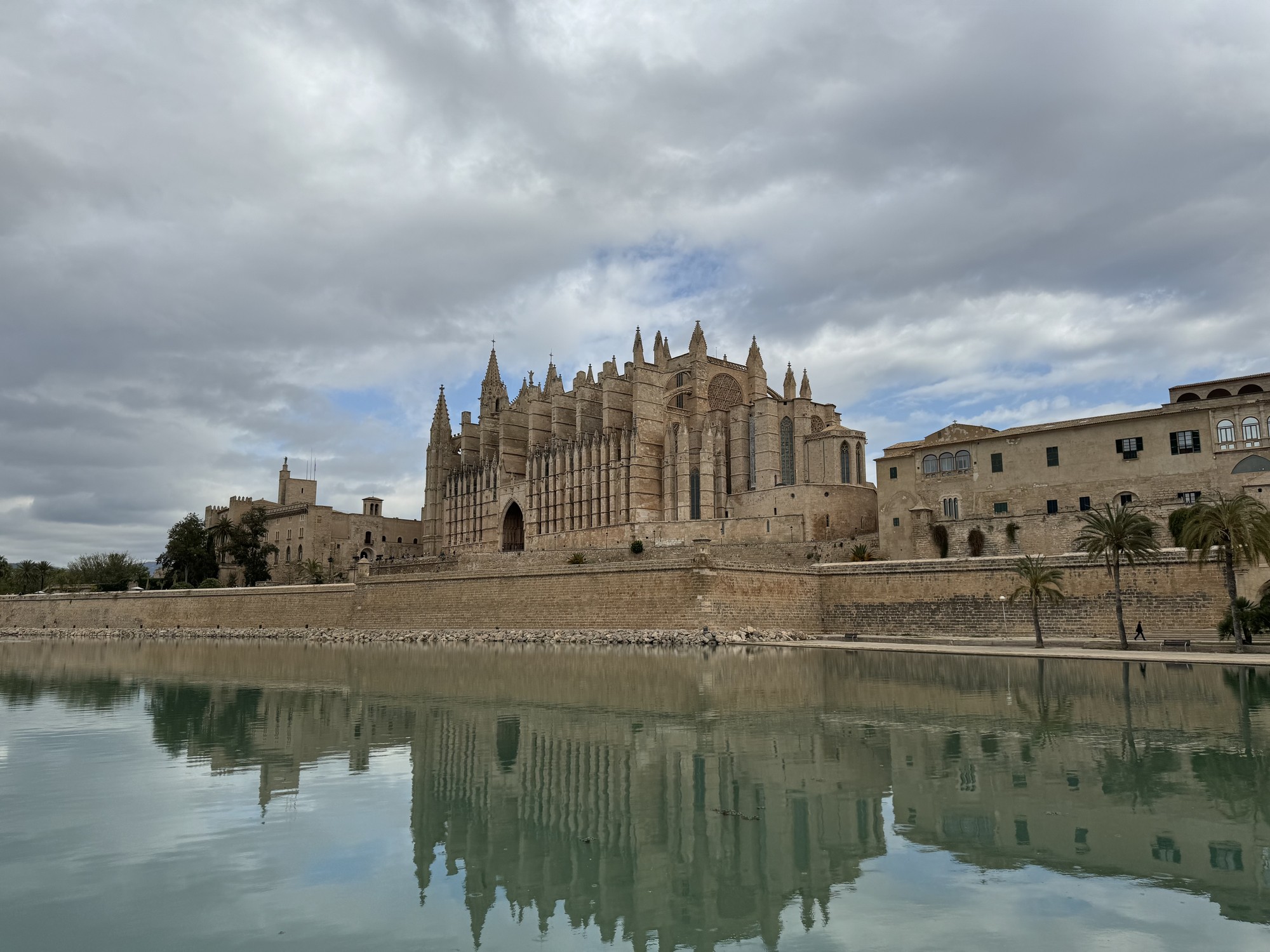
The short version: Palma’s old town is the one place in Mallorca where you can live in a historic palace, walk to the cathedral, the market and the seafront, and leave the car behind. The homes are palaces with stone courtyards and high-ceilinged principal floors, many divided into apartments, and renovating one takes time. In summer, streets with bars and boutique hotels come alive while Calatrava and the area around the cathedral stay quiet; in winter, the whole quarter goes silent. Parking is the real challenge.
What “the old town” means in Palma
Palma’s old town is the historic center enclosed by the ring of avenues known as the Avingudes and by the seafront. In the city’s official division it falls within the Centre district, a collection of small neighborhoods that residents still name one by one: la Seu, around the cathedral; la Calatrava, a quiet residential quarter of narrow lanes; la Llotja-Born, toward the seafront; Sant Nicolau, Sant Jaume, Monti-sion and el Puig de Sant Pere; and Cort, named after the square where the town hall stands.
The landmarks are the backdrop residents live with. The Royal Palace of La Almudaina, which dates from the 14th century, is the official residence of the King and Queen of Spain during their stays in Mallorca, and together with the cathedral it forms the city’s skyline from the bay. On the seafront, La Llotja, the 15th-century Gothic exchange that Guillem Sagrera built for the island’s merchants, once stood at the water’s edge as part of the sea wall; today it hosts exhibitions.
If you are still deciding between areas of the island, our guide on where to live in Mallorca describes every area; this one looks closely at a single neighborhood.
The homes: palaces, courtyards and the principal floor
The house that defines the old town is the Mallorcan town palace. From the street, it is often a sober stone façade with a large doorway; behind it opens a courtyard, the patio, with a stone staircase rising to the upper floors. The main living floor, the planta noble, is the one with the high ceilings and the largest rooms, the floor the house was built around.
Many of these palaces have been divided into apartments of very different sizes: a principal floor with ceilings of a height rarely built anymore, a top-floor apartment, or rooms around the courtyard. Alongside them stand more modest townhouses and apartment buildings, many of them already renovated. The streets are narrow, so how much light reaches each floor varies a great deal from one home to the next, and it is worth checking at different times of day.
A renovation here takes time
Buyers from the United States often expect to buy, renovate and move in within a season. In the old town, that is rarely how it goes. A palace divided into apartments has a community of owners, and anything that touches the shared parts, such as the façade, the courtyard, the staircase or the roof, goes through that community first. Permits for work in the historic center are slow to arrive, and the building sets its own pace: thick walls, old timber beams and stone worked by hand.
Renovations here are measured in long months rather than weeks, and the owners who enjoy the process most are those who planned for it from the start. The rules that apply to each building are a matter for your architect and your lawyer, not for this guide.
Two seasons, two old towns
The old town changes completely with the calendar. In summer, the streets with bars, terraces and boutique hotels in restored palaces fill with visitors from morning until late at night. If your bedroom faces one of those streets, you will hear it in summer.
A few minutes’ walk away, the picture is different. La Calatrava and the lanes around the cathedral, la Seu, remain residential and quiet even in August. In winter, the whole quarter goes silent: the visitors thin out and the streets belong to the people who live there.
Living without a car
Everything is within walking distance: the cathedral, the markets, the seafront, restaurants, banks and pharmacies. In what we see, many residents do without a car, or keep one outside the center for trips around the island.
The reason is the ACIRE, Palma’s restricted-traffic areas. According to the city’s mobility department, only authorized vehicles may drive in them, apart from exempt ones such as emergency services and motorcycles. There are currently twelve, including la Calatrava, Catedral, Sant Jaume, Santa Eulàlia, Plaça del Mercat and el Jonquet, with cameras at their entrances. Residents registered at an address inside a zone can apply for an authorization for their car, valid for five years; family members or carers can be authorized to drive to the door, but not to park inside. The old town also lies within the city center’s Low Emission Zone, where access depends on each vehicle’s environmental label.
The authorization lets you drive in; it does not give you a place to park. Garages in the old town are scarce, and a home with its own parking space is the exception rather than the rule. For many residents, the answer is a space in one of the car parks around the center.
The alternatives work well. The city puts its bike-lane network at more than 90 km, and the public bike system, BiciPalma, offers mechanical and electric bikes through an app. In pedestrian streets and squares, bikes are allowed only between 8 pm and 10 am and on public holidays, always giving way to pedestrians. Many lines of EMT, the municipal bus company, run along the avenues, with interchanges at Sindicat and Plaça d’Espanya; the A1 to the airport stops at Plaça d’Espanya, by the intermodal station.
Markets and daily errands
Two municipal markets serve the old town. The Mercat de l’Olivar, on Plaça de l’Olivar, has been open since 1951 and has its own car park. Its official hours are Monday to Friday from 7 am to 2:30 pm, with some stalls open until 8 pm, Saturdays from 7 am to 3 pm, and food bars until 4 pm; it is closed on Sundays. The Mercat de Santa Catalina, a short walk west of the old town, opens Monday to Saturday from 7 am to 3 pm for shopping and until 5 pm for its bars, and its fishmongers close on Mondays.
Beyond the markets, everyday shopping, pharmacies and restaurants are within a few streets. Online orders reach the old town too, although vehicles entering the restricted areas need an authorization, so deliveries follow their own logistics.
Health and schools
Son Espases University Hospital is the reference hospital for the Balearic Islands, and EMT line 6 runs between the hospital and Sindicat, on the edge of the old town. Private clinics and medical centers are spread across the city.
For families, most of the island’s international schools are in Palma, Calvià and Marratxí, and the school run is part of the daily logistics to plan. Our guide to international schools in Mallorca lists them with official data and distances.
Who lives in the old town
We would rather not draw a portrait of a typical buyer, because the old town does not have one. What the people who live here share is a choice: a historic home, a day done on foot, and a car that stays outside the center. Those who need a garage every evening, a garden or a silent street in August usually look elsewhere, and that is a perfectly good decision.
What nobody tells you
Moving in is a project of its own. Furniture often goes up a stone staircase, and removal vans need a one-off loading authorization to enter the restricted areas. Check the lift, the staircase and the street outside before you order furniture.
Rental cars need planning too. A resident who rents a car occasionally can notify the city by email, with the rental contract in their name; regular use requires an in-person appointment. Visitors without an authorization should know that a navigation app can route them straight through a camera-controlled street.
Finally, the same home can feel like two different places.
What you need to know
Can you live in Palma’s old town without a car?
Yes, and many residents do. Markets, shops and the seafront are within walking distance, the city has public bikes, and EMT buses run along the avenues, including the A1 to the airport.
What is ACIRE in Palma?
The ACIRE are Palma’s restricted-traffic areas: twelve zones in and around the old town where only authorized or exempt vehicles may drive, monitored by cameras. Registered residents can apply for an authorization for their car.
Is there parking in Palma’s old town?
Very little. Homes with their own garage space are the exception, and an ACIRE authorization lets you drive in but does not guarantee a place to park. Many residents rent a space in a car park around the center.
Is Palma’s old town noisy?
It depends on the street and the season. Streets with bars, terraces and boutique hotels are lively in summer, while la Calatrava and the area around the cathedral stay quiet; in winter, the whole quarter is calm.
What kind of homes are there in Palma’s old town?
Mostly town palaces with stone courtyards, many divided into apartments, with a principal floor of high ceilings, plus townhouses and renovated apartment buildings. Renovations take time because of shared buildings and slow permits.
Where we work
We work across Mallorca from our base in the south-east, where you can browse homes in Santanyí, homes in Ses Salines and homes in Campos. If you are considering Palma’s old town or any other area, contact Villas y Fincas Mallorca and we will answer in English.
Updated October 2026. Traffic areas, market hours and transport lines come from the official sources consulted in October 2026 and can change; the descriptions reflect what we see with our clients and are for general information only. This guide is not legal or planning advice.