
The short version: Cala Llombards is a sandy cove on the south-east coast of Mallorca, in the municipality of Santanyí, below the small village of Es Llombards. Fine sand, pines behind the beach and calm water make it the cove families in the area go to. In summer the parking fills very early in the morning, and there is one rule our clients hear from us before anything else: park only where it is allowed, never in residents-only areas. A beach bar opens in season; outside it there are no services, and the cove goes back to the people who live here, from neighbors on a walk to winter swimmers. Caló des Moro and s’Almunia are next door.
Where Cala Llombards is
Three names are easy to mix up here. Es Llombards is the inland village, a working Mallorcan village about 3.5 kilometers from both Santanyí and Ses Salines. Cala Llombards is both the cove and the small coastal hamlet built around it. And the municipality they belong to is Santanyí, at the south-eastern tip of the island.
The town hall places the hamlet of Cala Llombards between Cala Santanyí and s’Almonia, with a beach formed at the mouth of the Son Morlà stream as its center. The first house went up in the early 1960s, and in 1969 the residential area began on the land of the old Son Amer estate, as a neighborhood of single-family homes (Ajuntament de Santanyí). That is still the character of the hamlet above the beach: a neighborhood of detached houses on quiet streets.
If you are still deciding between areas of the island, our guide on where to live in Mallorca covers every area; this one looks closely at a single cove and the life around it.
The beach: fine sand, pines and calm water
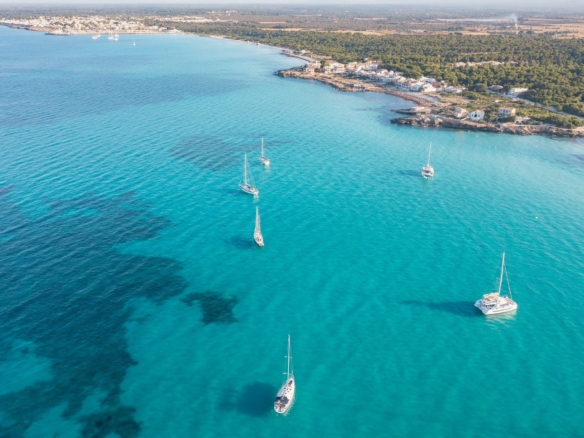
Cala Llombards is a narrow inlet that cuts deep into the land. Spain’s official tourism portal describes it as very sheltered from the open sea, with fine sand on the beach and on the seabed and vegetation all around, and gives its measurements as 55 meters long and 150 meters wide (spain.info, Turespaña). In practice, the sand runs a long way back from the water toward the pines, which is what the video above shows.
In what we see, three things make it the family cove of this stretch of coast: fine sand, pines framing the back of the beach and water that is usually calm inside the inlet, where small children can paddle at the edge. The same portal rates access on foot as easy, from the streets of the hamlet above the beach.
If you are used to American beaches with a boardwalk and a lot the size of a stadium, adjust the scale: this is a small cove inside a residential hamlet, and everything about visiting it follows from that.
Parking: early, and only where it is allowed
In summer, the parking at Cala Llombards fills very early, at the start of the morning. Those who arrive late in July or August often find nothing, and the answer is to come back another time, not to improvise.
There is a car park in Cala Llombards beside the street that gives access to the coast, and there are designated parking areas in the hamlet. Beyond them, this is a neighborhood where people live all year, and some areas are reserved for residents. Our rule, which we repeat to every client who visits with us: never park in a residents-only area or anywhere illegal.
The same parking serves Caló des Moro and s’Almunia, which explains why it fills so fast.
Summer and winter: two different coves
From late spring to early autumn, Cala Llombards works as a summer beach. A beach bar, a chiringuito, opens in season. The town hall has included the cove in its beach lifeguard service: the contract published in the official gazette for 2018, for example, covered Cala Santanyí, Cala Llombards, Cala Gran and sa Font de n’Alis–s’Amarador, for a season running at least from May 1 to October 31, from 10 am to 6 pm and until 7:30 pm in July and August (BOIB, Ajuntament de Santanyí). Each year’s service is set by the town hall.
Outside the season there are no services at all: no beach bar and nothing to buy, so people bring what they need. And the cove changes character. In winter, Cala Llombards becomes the village’s cove: neighbors walking on the sand and the winter swimmers who keep going into the sea long after the visitors have gone. For anyone deciding whether to live in this corner of the island, that winter picture matters more than the August one.
Caló des Moro and s’Almunia, next door
Cala Llombards shares its stretch of coast with two coves that draw visitors from all over the island, both within a short walk, and many people who park here are heading for them rather than for Cala Llombards itself.
- Caló des Moro: a small cove reached by a steep descent over rock and steps, with no services of any kind. In what we see, it is not a place for small children or bad knees.
- S’Almunia, written s’Almonia by the town hall: fishermen’s boathouses and rock platforms, reached by steps, which our clients prefer outside July and August and early in the day.
Both share the parking areas of Cala Llombards, with the same rule. That is why, for many families, the practical choice in summer is Cala Llombards itself. Toward Cala Santanyí, the rock arch of Es Pontàs is seen from a viewpoint beside the road, and many people stop there at sunset.
Es Llombards and Santanyí: the villages behind the cove
Life around Cala Llombards runs through two villages. Es Llombards, according to the town hall, has land that includes Cap de ses Salines, the southernmost point of Mallorca, and it reached its peak population in 1950, with 638 inhabitants. It holds a market on Thursday mornings in the Plaça des Pou, with fruit, vegetables and some crafts, celebrates Santo Domingo on August 8 and its patron, the Immaculate Conception, on December 8 (Ajuntament de Santanyí).
Santanyí is the main village, with the secondary school, the health center, the shops and the Wednesday and Saturday market. Our guide to Santanyí, Cala Figuera and Es Llombards explains how the village lives through the year and who buys there.
Getting there and getting around
Driving times below come from OpenStreetMap routing, from Cala Llombards beach, in free-flowing traffic:
- Es Llombards: about 9 minutes.
- Santanyí: about 10 to 11 minutes.
- Ses Salines: about 14 minutes.
- Cala Figuera: about 18 minutes.
- Campos: about 23 minutes.
- Palma airport: about 48 minutes.
- Central Palma (the cathedral): about 58 minutes.
In daily practice we count on around an hour to the airport and to Palma, more in summer. A car is part of everyday life: the shops and services are in the villages.
Living near Cala Llombards
In what we see, homes near the cove fall into three groups: single-family houses in the hamlet of Cala Llombards itself, a few minutes’ walk from the sand; village houses in Es Llombards, lived in all year; and country houses with land between the villages, with space, silence and a pool, about ten minutes from the sea. Across the south-east, buyers often find more house and more land than in the south-west of the island.
The profiles we see buying in this part of Mallorca are couples who work remotely, usually between 35 and 55, and buyers of a second home. What they share is that they want a working village and the coves within minutes, rather than a resort.
What nobody tells you
The beach bar is seasonal. At the edges of the season, check before counting on it.
August and January tell different stories. The clients of ours who choose this corner of the island usually know both: an August morning, with the designated spaces full from the first hours of the day, and a weekday in January, with the winter swimmers, a quiet hamlet and Es Llombards going about its week.
What you need to know
Where do you park at Cala Llombards?
In the car park beside the street that gives access to the coast and in the designated parking areas of the hamlet. Never in residents-only areas or anywhere illegal. In summer it fills very early in the morning.
Is Cala Llombards good for children?
It is the cove families in the area go to: fine sand, pines behind the beach and water that is usually calm inside the inlet, with easy access on foot from the hamlet.
Is there a beach bar at Cala Llombards?
Yes, in season. Outside the season there are no services, so bring water and anything else you need.
Is there a lifeguard at Cala Llombards?
The town hall has included Cala Llombards in its seasonal beach lifeguard service, which in 2018 ran from May to October. There is no lifeguard outside the season.
How far is Cala Llombards from Caló des Moro and Santanyí?
Caló des Moro is a short walk along the coast and shares the same parking areas. Santanyí is about 10 to 11 minutes by car, according to OpenStreetMap routing.
Where we work
Cala Llombards is part of our own corner of the island. We work across Mallorca from our base in the south-east, where you can browse homes in Santanyí, homes in Ses Salines and homes in Campos. Whatever area you are considering, contact Villas y Fincas Mallorca and we will answer in English.
Updated October 2026. Driving times come from OpenStreetMap routing and vary with traffic and season; facts about Cala Llombards and Es Llombards come from the official website of the Ajuntament de Santanyí, those about the beach from spain.info (Turespaña) and those about the lifeguard service from the Butlletí Oficial de les Illes Balears, all consulted in October 2026. The descriptions reflect what we see with our clients and are for general information only.