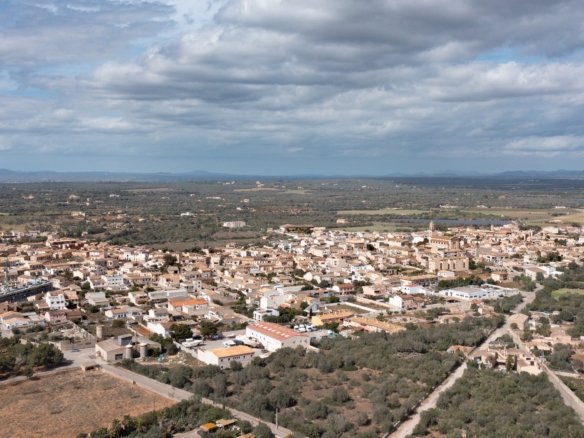

The short version: Santanyí is the main village of the municipality of the same name, at the south-eastern tip of Mallorca, built in the golden stone that carries its name. It lives all year round, with a secondary school, shops and a market on Wednesday and Saturday mornings; the Saturday market fills the village in every season. In what we see, it is one of the most sought-after villages on the island, with a strong German presence. A few minutes away are Cala Figuera, a fishing harbor that looks like a postcard, and Es Llombards, a small village with Cala Llombards and Caló des Moro on its coast.
A village built in its own stone
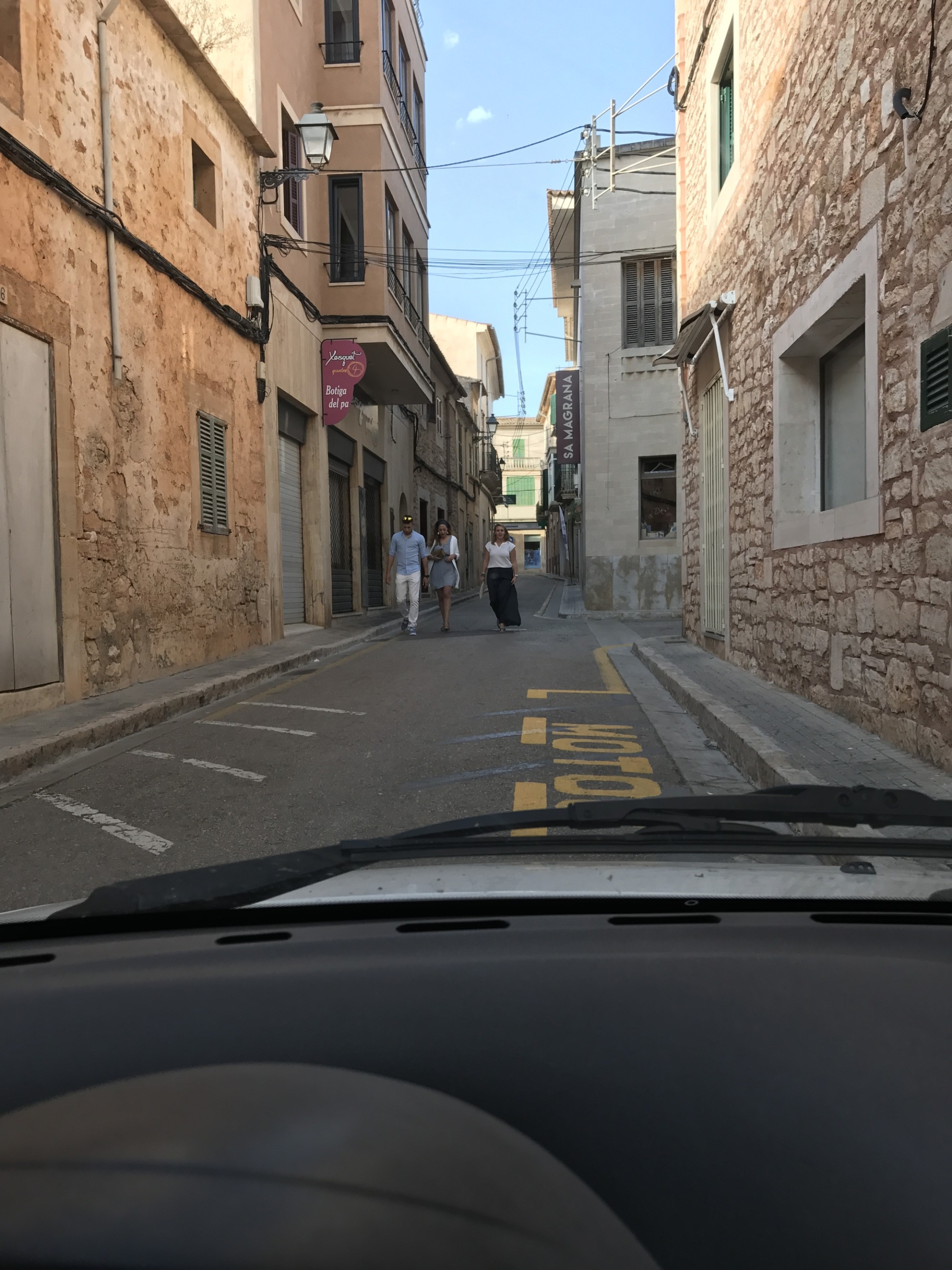
Santanyí lies about 52 kilometers by road south-east of Palma (from Plaça d’Espanya to the Ajuntament, OSRM on OpenStreetMap, October 19, 2026). The town hall’s own walk through the village starts in the Plaça Major, which it calls the heart of the village, where residents meet and where the festivities and the market are held, between the town hall and the church of Sant Andreu (Ajuntament de Santanyí). The church, begun in 1786, is built of Santanyí stone, and its baroque organ came from a convent in Palma by sea, landed at Cala Figuera. A few streets away, the Porta Murada, a 16th-century gate tower, is what remains of the old village walls.
In what we see, the stone gives Santanyí its color, a warm gold on façades, garden walls and country houses across the municipality. Around the square, art galleries, restaurants and a remarkable number of shops sit side by side, and the town hall’s calendar adds an international music festival and a visual arts prize named after the village.
Market days: Wednesday and Saturday
According to the town hall, the market is held on Wednesday and Saturday mornings in the Plaça Major, with fruit and vegetables, clothing and other goods (Ajuntament de Santanyí). The stalls spill into the surrounding streets, as the video shows.
The Saturday market is crowded all year, in January as much as in July. The Wednesday market is noticeably calmer outside the high season. Residents do their shopping on Wednesday and, on Saturday, either go early or leave the center to the visitors. The calendar has other fixed dates: the Fira de Santanyí, an agricultural, craft and trade fair on the third Saturday of October, and Sant Andreu, the patron saint, on 30 November.
Mallorcans, Germans and a village that lives all year
Santanyí mixes Mallorcan families and foreign residents. In what we see, the German community is the most visible of the foreign ones, and many of the people we see buying here are Germans with high purchasing power, which shows in the shops, the galleries and the restaurants.
The town hall’s directory lists a secondary school, the Institut d’Ensenyament Secundari, and several primary schools across the municipality, one of them in Es Llombards (Ajuntament de Santanyí). Add a health center, pharmacies, banks, supermarkets and shops that stay open in winter, and Santanyí covers daily life without a trip to Palma. In summer the village is busier and the coast roads slower; in winter, in what we see, it keeps its rhythm while the coastal hamlets around it become very quiet.
Cala Figuera: the postcard harbor
Cala Figuera is about seven minutes from the village by road. The town hall describes it as a settlement formed by two narrow inlets, the Caleta d’en Boira and the Caleta d’en Busquets, documented as early as 1306. Santanyí stone was shipped from here; the first building was a shed for boats, from the mid-19th century, and a small fish market and the quay were built in 1950 (Ajuntament de Santanyí). The Torre d’en Beu, a defense tower begun in 1569, recalls the centuries of pirate raids on this coast, and every 16 July the feast of the Carme ends with a procession at sea.
In what we see, this is the harbor people photograph: boathouses at the water’s edge, small boats and homes stepping up the sides of the inlets.
Es Llombards, Cala Llombards and Caló des Moro
Es Llombards is a small village about 3.5 kilometers from both Santanyí and Ses Salines, according to the town hall, and its land includes Cap de ses Salines, the southernmost point of Mallorca. It has its own primary school, a medical unit, a cheese dairy founded in 1941 and a market on Thursday mornings in the Plaça des Pou. It keeps the pace of a Mallorcan village, five minutes from everything Santanyí offers.
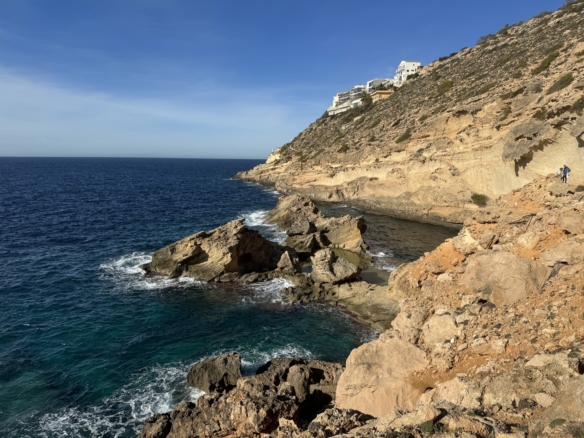
Cala Llombards is the coastal hamlet below it, between Cala Santanyí and s’Almonia, around a sandy beach at the mouth of the Son Morlà stream. The town hall dates its residential area to 1969, on the old Son Amer estate, as a neighborhood of single-family homes. A short walk along the coast leads to Caló des Moro: a steep descent over rock and steps, with no services at all.
Mondragó Natural Park
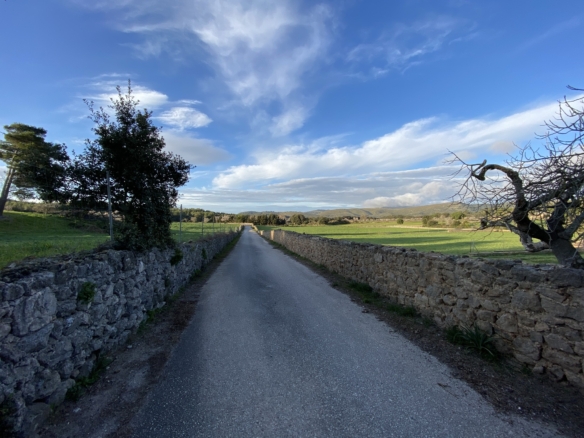
On the eastern side of the municipality, Mondragó was declared a Natural Park in 1992. The Balearic government describes a mosaic of woodland, wetlands, beaches and dunes, cliffs and farmland, most of it privately owned dryland fields crossed by dry-stone walls, and notes that it is part of the Natura 2000 network (Govern de les Illes Balears). It has two car parks, at s’Amarador and at ses Fonts de n’Alis; s’Amarador is about eleven minutes from Santanyí by road.
The homes: village, countryside and coast
Three kinds of home define the area:
- Village houses in Santanyí and Es Llombards, many in local stone, within walking distance of the square and the school.
- Country houses with land between the villages: space, silence, a pool and the sea about ten minutes away.
- Homes on the coast: single-family houses in Cala Llombards and the other coastal hamlets, and homes above the inlets of Cala Figuera.
Getting around: Palma, the airport and the coves
Driving times below were measured on October 19, 2026 with OSRM on OpenStreetMap (car, free-flowing traffic), from Plaça d’Espanya in Palma and from the airport terminal to the center of each village:
- Santanyí: about 44 minutes from Plaça d’Espanya in Palma and about 43 from the airport.
- Es Llombards: about 46 minutes from Plaça d’Espanya in Palma and about 45 from the airport.
- Cala Figuera: about 50 minutes from Plaça d’Espanya in Palma and about 49 from the airport.
From Santanyí, Es Llombards is about 5 minutes away, Cala Santanyí 7, Cala Figuera 7, Cala Llombards 10, Ses Salines 10, Campos 16, Cala d’Or 17 and Manacor 31 (measured from the Ajuntament of Santanyí). With normal traffic, allow somewhat more, and extra time in summer. A car is part of everyday life. For families, our guide to international schools in Mallorca lists each school with official details and distances.
Who buys in Santanyí
In what we see with our clients, the main profile here is the German buyer with high purchasing power, often after a village house in the center or a country house nearby. Across the south-east we also see couples who work remotely, usually between 35 and 55, and buyers of a second home. To compare Santanyí with the rest of the island, our guide to where to live in Mallorca covers every area.
What nobody tells you
The international side is not for everyone. The German presence is so visible that, in what we see, many German buyers prefer not to live in the village itself: they came for a Mallorcan day-to-day and find it a few minutes away, in Es Llombards, Ses Salines or the countryside. Others choose Santanyí precisely for that ease. Seeing the village on a Saturday and on a winter Tuesday tells you which side you are on.
Park where you are allowed to, always. For Caló des Moro, cars go only in the designated areas of Cala Llombards, including the car park beside the street that leads to the path. Never in residents-only zones or anywhere illegal.
The coves sleep in winter; the village does not. Outside summer, Cala Figuera and Cala Llombards are almost silent, while Santanyí carries on with its school run, its market and its shops.
What you need to know
When is the market in Santanyí?
On Wednesday and Saturday mornings in the Plaça Major, according to the town hall. The Saturday market is crowded all year; the Wednesday one is calmer outside the high season. Es Llombards has its own market on Thursday mornings.
How far is Santanyí from Palma airport?
About 43 minutes from the airport terminal to Santanyí in free-flowing traffic (OSRM on OpenStreetMap, October 19, 2026). With normal traffic, somewhat more, and more in summer.
Is Santanyí lively in winter?
Yes. The village has a secondary school, a health center and shops open all year. The coastal hamlets, such as Cala Figuera and Cala Llombards, are very quiet outside summer.
Where do you park for Caló des Moro?
Only in the designated parking areas of Cala Llombards, never in residents-only zones or anywhere illegal. The path down to the cove is steep and there are no services.
What is the difference between Santanyí and Es Llombards?
Santanyí is the main village, with the services and the Wednesday and Saturday market. Es Llombards is a small village about 3.5 kilometers away, with a Thursday market and Cala Llombards and Caló des Moro on its coast.
Where we work
Santanyí is part of our own corner of the island. We work across Mallorca from our base in the south-east, where you can browse homes in Santanyí, homes in Ses Salines and homes in Campos. Whatever area you are considering, contact Villas y Fincas Mallorca and we will answer in English.
Updated October 2026. Driving times, measured on October 19, 2026 with OSRM on OpenStreetMap (car, free-flowing traffic) from Plaça d’Espanya in Palma, the airport terminal and the Ajuntament of Santanyí, vary with traffic and season; facts about the village, its market and fairs, Cala Figuera, Es Llombards and Cala Llombards come from the official website of the Ajuntament de Santanyí, and those about Mondragó from the Govern de les Illes Balears, both consulted in October 2026. The descriptions reflect what we see with our clients and are for general information only.