
The short version: Caló des Moro is a very small cove on the south-east coast of Mallorca, in the municipality of Santanyí, on the coast below the hamlet of Cala Llombards and a few minutes from the fishermen’s boathouses of s’Almunia. You reach it on foot, about a kilometer and a half from the entrance to Cala Llombards, and the last stretch is a steep descent over rock and steps: in what we see, not a place for small children or bad knees. There are no services of any kind, so water, shade and proper shoes come with you. And there is one thing we ask of everyone who visits with us, before anything else: park only in the car park and the designated areas of Cala Llombards, never in a residents-only zone and never anywhere illegal.
Where Caló des Moro is
Caló des Moro sits on the stretch of coast south-west of Cala Llombards, right next to s’Almunia, in the far south-east of Mallorca. It belongs to the municipality of Santanyí, and the nearest village is Es Llombards, a few minutes inland. There is no road down to the water: the cove is reached on foot from Cala Llombards.
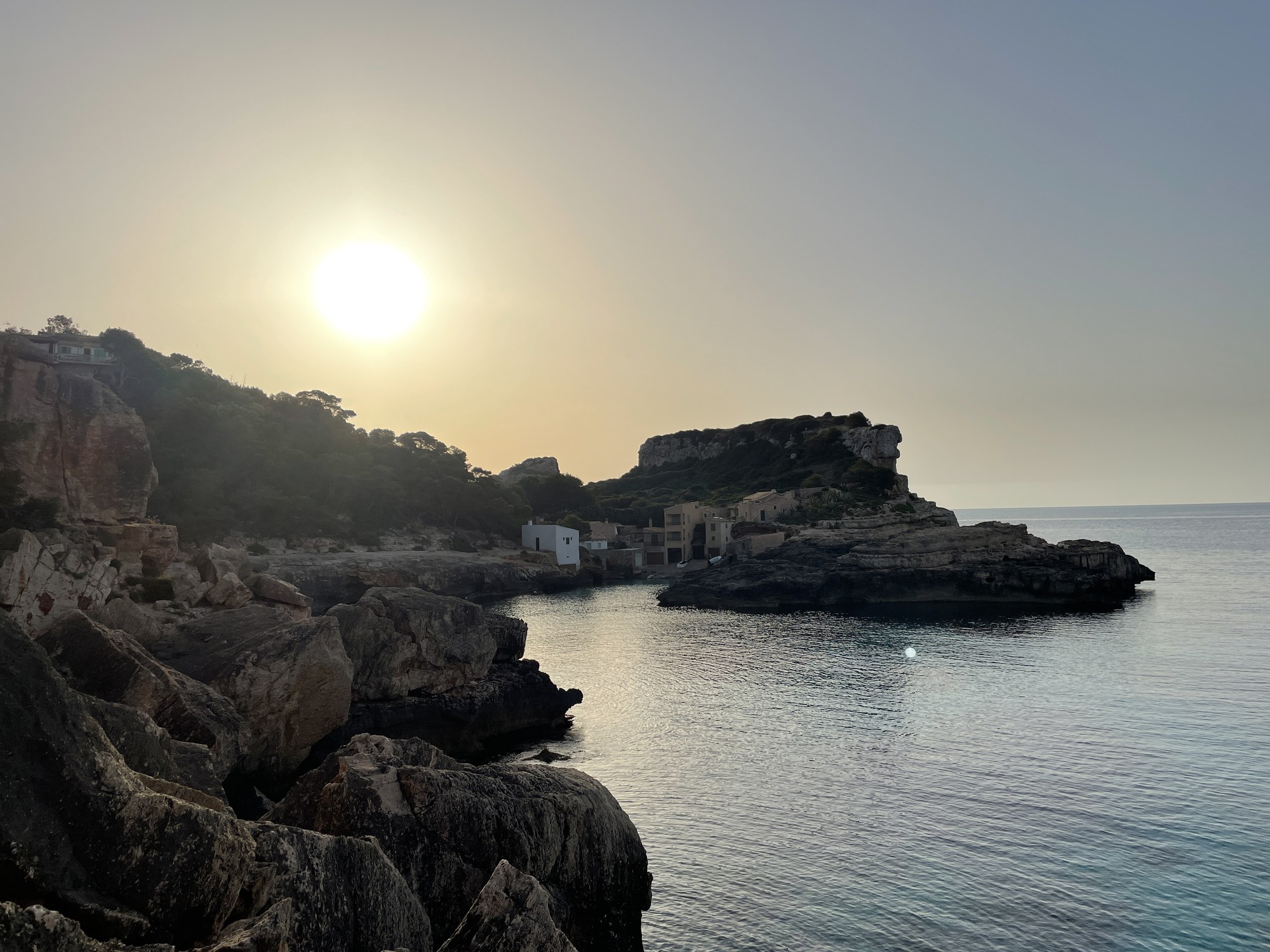
Spain’s official tourism portal lists it as a beach of gravel and white sand, 30 meters long and 20 meters wide, with a sandy and rocky seabed and moderate waves, and rates access on foot as difficult (spain.info, Turespaña). Thirty meters is about a third of a football field. That is the first adjustment for anyone who knows the cove from photographs: it is a narrow slot of water between walls of rock, with a small patch of sand at the end.
If you are still comparing areas of the island, our guide on where to live in Mallorca covers every region; this one looks at a single cove and the neighborhood that surrounds it.
The descent: steep, over rock and steps
From the entrance to Cala Llombards, the town hall puts the walk to Caló des Moro and s’Almunia at about a kilometer and a half (Ajuntament de Santanyí). OpenStreetMap walking directions give a similar figure, about 1.7 kilometers from the car park and just over twenty minutes at an easy pace.
The final stretch down to the water is steep and runs over bare rock and steps. In what we see, it is not a place for small children, for strollers or for anyone with bad knees or limited mobility, and the climb back up in the heat of the afternoon is harder than the way down.
For families with young children, the practical alternative is next door: Cala Llombards, a sandy cove with easy access, pines behind the beach and a beach bar in season.
Parking: the one rule that matters
This is the part of the guide we would most like every visitor to read. Caló des Moro has no parking of its own. There is a car park in Cala Llombards beside the street that gives access to the coast, and there are designated parking areas in the hamlet. That is where cars go, and when they are full, the answer is another day or another cove.
Cala Llombards and s’Almunia are neighborhoods where people live all year, and some of their streets are reserved for residents. Since 2018, the town hall has used summer restrictions that let only residents’ vehicles into s’Almunia, with a barrier controlled by the local police, and in 2022 it extended the restricted zone to twenty streets of Cala Llombards (Ajuntament de Santanyí). The details are set season by season and signposted on the spot.
Our rule, which we repeat to every client who comes with us: never park in a residents-only area or anywhere illegal. The town hall itself has explained its restrictions by the need for garbage trucks and ambulances to get through these narrow streets without obstacles.
No services: what to bring
Caló des Moro has no beach bar, no restrooms, no shade on the sand and nothing to buy. If you picture an American state beach with a lot, a snack stand and a lifeguard tower, this is the opposite: a cove in its natural state that you visit with what you carry.
Everything that comes in goes back out, rubbish included.
S’Almunia, next door, when the cove is full
A few minutes on foot from Caló des Moro, s’Almunia (written s’Almonia by the town hall) is a small inlet lined with fishermen’s boathouses, with platforms of rock above clear water and steps down to the sea. It shares the same approach and the same parking areas in Cala Llombards, with the same rule.
When Caló des Moro is full, which in summer happens often, s’Almunia is where people go instead. There is no sand, but there is rock to sit on and water to swim in, and the boathouses give it a character of its own.
A small cove that draws a lot of people
Caló des Moro has spread widely on social media, and in summer the visitors are far more than its thirty meters of sand can hold. It is described as a practical fact, because it shapes the visit: on a busy day, the space at the end of the descent may simply be taken.
In June 2024, the town hall explained that its local police see the number of visitors rise whenever the cove appears in the news or in social media posts (Ajuntament de Santanyí). In March 2025 it announced an agreement with the University of the Balearic Islands, through its foundation FUEIB, to study the carrying capacity of Caló des Moro over the summer with automatic visitor counters, drone observation, surveys and environmental data, so that future management decisions rest on scientific criteria (Ajuntament de Santanyí). No visitor limit announced on the town hall’s website could be found at the time of writing. Any rule for a new season will be published there and signposted at the access.
Getting there and getting around
Driving times below come from OpenStreetMap routing, from the entrance to Cala Llombards, where the car park is, in free-flowing traffic:
- Es Llombards: about 6 minutes.
- Santanyí: about 7 to 8 minutes.
- Ses Salines: about 11 minutes.
- Cala Figuera: about 12 to 13 minutes.
- Campos: about 21 minutes.
- Palma airport: about 47 minutes.
- Central Palma (the cathedral): about 55 minutes.
Add the walk, just over twenty minutes each way. In daily practice we count on around an hour to the airport and to Palma, more in summer.
Living near Caló des Moro
The cove belongs to a corner of the island where people live all year. Above it, the hamlet of Cala Llombards is a neighborhood of detached houses on quiet streets; inland, Es Llombards keeps the pace of a working Mallorcan village; and Santanyí, a few minutes away by car, has the secondary school, the health center, the shops and the Wednesday and Saturday market. Our guide to Santanyí, Cala Figuera and Es Llombards explains how the area lives through the year.
The profiles we see buying in this part of Mallorca are couples who work remotely, usually between 35 and 55, and buyers of a second home.
What nobody tells you
The photographs make it look bigger. Thirty meters of sand fill up quickly; the rock around the water is where most people end up sitting.
The residents remember the cars. In what we see, a visitor who walks in from the car park goes unnoticed. A car on a residents’ street is what the neighbors talk about all summer.
What you need to know
How do you get to Caló des Moro?
On foot. From the entrance to Cala Llombards it is about a kilometer and a half, according to the town hall, a walk of just over twenty minutes ending in a steep descent over rock and steps.
Where do you park for Caló des Moro?
In the car park in Cala Llombards beside the street that gives access to the coast, or in the designated parking areas of the hamlet. Never in residents-only areas or anywhere illegal.
Is Caló des Moro suitable for children?
In what we see, not for small children: the descent is steep and runs over rock and steps. Cala Llombards, next door, is the sandy cove families use.
Are there services at Caló des Moro?
None: no beach bar, no restrooms and no shade on the sand. Bring water, sun protection and shoes suitable for rock.
What if Caló des Moro is full?
S’Almunia is a few minutes away on foot, with rock platforms and fishermen’s boathouses, and shares the same approach. Cala Llombards is the other option nearby.
Where we work
Caló des Moro is part of our own corner of the island. We work across Mallorca from our base in the south-east, where you can browse homes in Santanyí, homes in Ses Salines and homes in Campos. Whatever area you are considering, contact Villas y Fincas Mallorca and we will answer in English.
Updated October 2026. Driving and walking times come from OpenStreetMap routing and vary with traffic and season; facts about access, residents’ parking and the carrying-capacity study come from the official website of the Ajuntament de Santanyí, and those about the beach from spain.info (Turespaña), all consulted in October 2026. Access rules are set by the town hall each season. The descriptions reflect what we see with our clients and are for general information only.