

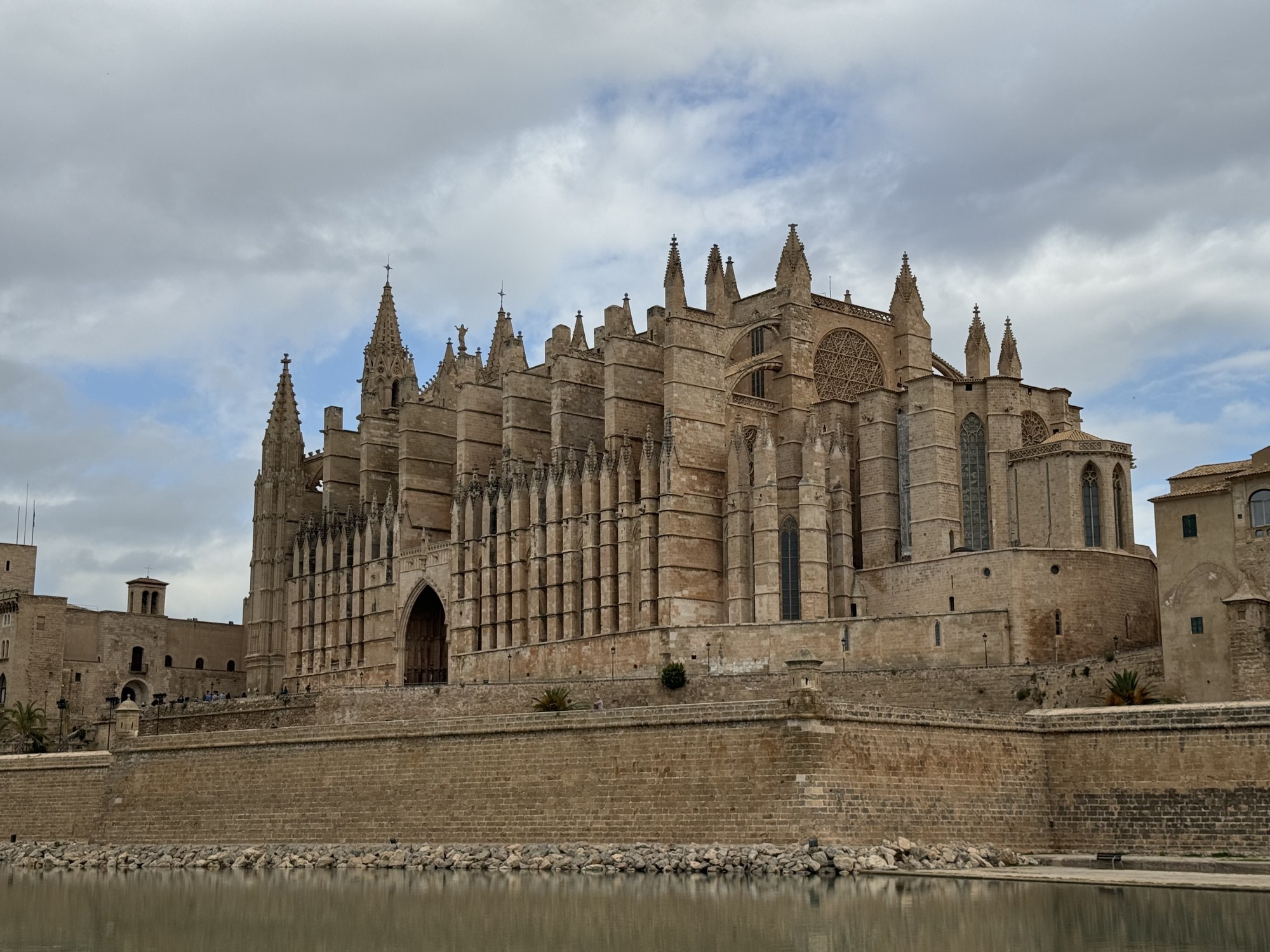
The short version: twice a year, on February 2 and November 11, the morning sun enters Palma Cathedral through its great east rose window and throws a colored image of it onto the inside of the west wall, directly under the smaller rose window there. For a few minutes the two circles sit one above the other, and the cathedral’s own name for the moment is the Festa de la Llum, the Festival of Light. This story follows how the effect works, what the cathedral and a 2010 scientific study say about why it happens, and a second, less known alignment around Christmas. It gives no opening hours or admission details, because the cathedral publishes those.
What happens, and when
The cathedral’s own description is plain: every February 2 and every November 11, sunlight that enters through the main rose window, also called the Gothic Eye, is projected just below the rose window on the inner wall of the main portal. A study published in 2010 by two mathematicians of the Balearic Mathematical Society, Daniel Ruiz Aguilera and Josep Lluís Pol Llompart, adds the geometry: the projection lines up with the west rose window so that the two circles are tangent, and the line joining their centers is vertical.
The study says the effect happens between 8:30 and 9:00 in the morning, local time, depending on the day, and that the two dates sit in more or less equivalent positions on either side of the winter solstice, which is why the same alignment occurs around both. The cathedral’s notices of 2022 and 2025 give 8:30 as the moment of the alignment. The sun has to cooperate: on February 2, 2025, the cathedral reported, clouds covered it at 9:00 and the two circles never stood exactly one above the other.
Two windows from two centuries
The show needs two openings in two different walls, and the study’s chronology shows how differently they were made. Around 1370, it says, the enlargement of the great nave made three rose windows necessary, among them the central east one, the Oculus Maior. That window threatened to fail in 1581 and collapsed in December 1588; the study dates its reglazing in colored glass to 1599. The smaller west rose window was finished in 1598, according to the same chronology. The Oculus Maior later suffered damage in 1857, 1906 and 1936, in turn from a storm, lightning and a bomb, and its glass was replaced.
The cathedral, for its part, explains that the inner wall where the image lands belongs to a façade built in three stages, between the 16th-17th and 19th centuries, with two different fronts, one inside and one outside, a decisive factor for where the rose window appears on that wall. It adds that the conditions for light entering the cathedral have been stable since the main rose window’s full restoration, which the cathedral dates to 2010 and the 2010 study to October 2008 through July 2009. The size is quoted differently across official pages: the cathedral’s own 2022 and 2025 notices say 11.85 meters in outer diameter and 1,115 panes of glass, one later notice says 11.38 meters, and the Balearic Government’s tourism page says about 13 meters. We do not choose between them.
Luck or design?
The question people ask is whether the builders planned it. The cathedral’s answer, given at a round table on the eve of the February 2022 edition and reported on its news page, is that the light effect is the result of chance, shaped by structural factors that arose over time. One of the speakers, an art historian and architectural technician, said the initial plan did not include the main rose window at all, which came with the change of design and the widening of the building, and that its geometric patterns respond to a structural need, since those forms distribute weight well. The Balearic Government’s page agrees that experts believe the rose windows were not built on purpose to create the phenomenon.
The 2010 study reaches a similar conclusion from the orientation. It measures the axis of the central nave at an azimuth of 122.4 degrees, with an uncertainty under half a degree, against 120.3 degrees for sunrise at the winter solstice in Palma. The authors write that the orientation was fixed by the first chapels built, the Trinity and Royal chapels, so they cannot claim the light effects were sought. Their own hypothesis is symbolic: that the head of the cathedral was oriented toward the point where the sun rises on the shortest day, with the light effects a consequence rather than a coincidence. They also report that the bell tower has its own axis, about 110 degrees, and that probes in its walls point to Arab masonry that may belong to the old minaret, which would have faced Mecca. They add that, unlike some churches in France and Italy, no meridian line or astronomical use is known for Palma’s cathedral.
The second alignment, around Christmas
The same study describes a second effect that fewer people know. Around Christmas, the rays of the rising sun pass through the Oculus Maior and coincide exactly with the west rose window, so that from a suitable point outside the cathedral the west rose window looks lit from inside. The authors say they first heard of it in 2007, from a canon of the cathedral, and found a spot to watch it on the surviving stretch of wall at the Bastion of Sant Pere, now part of the grounds of the Es Baluard museum. They write that for about twenty days around the winter solstice, weather permitting, the sunrise can be seen through both rose windows.
Es Baluard’s own 2012 notice describes the same thing as happening every year around the winter solstice, with the cathedral turning into a giant kaleidoscope of color seen from the museum, and credits the Balearic Mathematical Society with discovering, studying and spreading the effect. That museum is stop two of our walk across Palma in one day.
From the Spectacle of the Eight to the Festival of Light
The name has a history of its own. According to the cathedral, from 2015 it called the event the Spectacle of the Eight, a name meant to catch the attention of the media and tied to a possible numeric symbolism; from 2018 it chose Festival of Light, closer to the religious and spiritual meaning of the phenomenon. The cathedral says the same two researchers were the first to explain the effect, from 2007.
The dates carry meaning too. February 2 is Candlemas, forty days after Christmas, when the presentation of Jesus in the temple is commemorated, and November 11 is Saint Martin’s Day. The cathedral says that with the name Festival of Light it wants to recover a cultural tradition of Greek and Roman origin that Pope Gelasius Christianized in the year 496, tied to the offering and blessing of wax candles at Candlemas. The 2010 study adds that Candlemas 2007 was also the day Miquel Barceló’s Chapel of the Blessed Sacrament was inaugurated, the work our story on Palma on foot mentions among the cathedral’s latest additions.
What the mornings have looked like
The cathedral gives attendance for recent editions. It counted more than 1,600 people on February 2, 2025, and 1,500 on November 11, 2025. On the November morning, it wrote, the double rose window was clearly visible at 8:30 even though clouds had nearly erased the colors in the minutes before, and applause was heard when the image formed. The cathedral also streams the event on its YouTube channel, and in 2025 it announced a guided visit about light in the Seu, held the day after the November event; its news page is where each year’s arrangements are announced, together with opening times and admission. The dates are February 2 and November 11 every year; what the cathedral will organize on them is for the cathedral to say.
The cathedral and its neighbors
Our guide to living in Palma’s old town covers daily life around it. Two other Gothic churches of the city are in Santa Eulàlia and Sant Francesc, the old noble houses are in the hidden courtyards of Palma, and why Mallorcans call their capital Ciutat is in its own story.
What you need to know
When does the double rose window appear in Palma Cathedral?
On February 2, Candlemas, and November 11, Saint Martin’s Day, according to the cathedral. The 2010 study places the alignment between 8:30 and 9:00 in the morning, depending on the day, and says the effect occurs around those dates.
Is the effect planned by the builders?
The cathedral says it is the result of chance and of structural factors that arose over centuries. The 2010 study finds the orientation was fixed by the first chapels, so it cannot claim the light effects were sought.
What is the second light effect?
Around Christmas, for about twenty days around the winter solstice, the sunrise can be seen through both rose windows from the wall at the Bastion of Sant Pere, which is part of the Es Baluard museum grounds, according to the 2010 study.
What happens if it is cloudy?
The effect is reduced or lost. On February 2, 2025, clouds covered the sun at 9:00 and the alignment was incomplete, according to the cathedral; the colored reflection was still seen before and after.
Where do I find this year’s arrangements?
On the cathedral’s own news page, which announces each edition. We do not give hours or admission details here.
Where we work
We work across Mallorca from our base in the south-east, where you can browse homes in Santanyí, homes in Ses Salines and homes in Campos. To compare Palma with the rest of the island, see our guide on where to live in Mallorca, or contact Villas y Fincas Mallorca and we will answer in English.
Updated October 2026. Facts come from the Cathedral of Mallorca’s news pages (catedraldemallorca.org, notices published between 2021 and 2025), the Balearic Government’s tourism site (illesbalears.travel), the Es Baluard museum, and the 2010 study by Ruiz Aguilera and Pol Llompart of the Balearic Mathematical Society in the journal Actes d’Història de la Ciència i de la Tècnica, all consulted in October 2026. Official sources differ on the size of the rose window and on the date its restoration ended. Weather decides what is seen on each morning. This story is for general information only.